
Outlet Dead but Breaker Not Tripped? 6 Reasons to Check First
QUICK ANSWER: A dead outlet with an untripped breaker almost always means power is being cut somewhere between the panel and that outlet, not at the panel itself. The most common culprit is a GFCI outlet in another room that tripped and took a whole string of ordinary outlets down with it. Other causes include a half-hot outlet controlled by a wall switch, a loose or slipped wire connection, a breaker that failed while still looking on, or a worn-out outlet at the end of its life. Reset any tripped GFCIs, check the wall switches, and cycle the breaker fully off, then on. If the outlet is warm, discolored, or smells like burning plastic, stop and call an electrician.
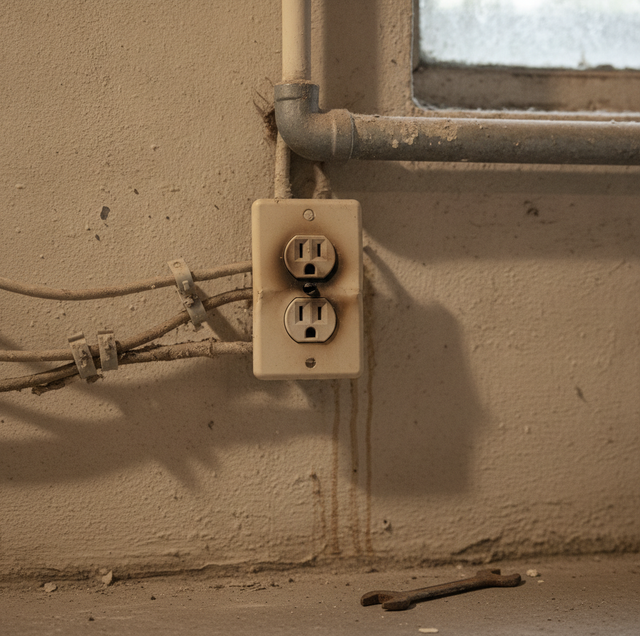
A wall outlet goes quiet. The lamp plugged into it stays dark, the phone charger reads nothing, and you walk to the panel expecting a breaker flipped halfway. Instead, every handle sits neatly in the ON position. Nothing looks wrong, yet the outlet is dead.
What "No Power, No Trip" Actually Tells You
Electricity leaves your panel on a breaker, travels through wire to a series of outlets, and returns. When the breaker is still on but an outlet is dead, the break in that path has happened downstream of the panel. Somewhere between the breaker and the receptacle in your wall, the circuit has opened. That is useful information because it narrows the search: the panel already did its job, or was never the problem. The fault lives out in the run.
A garden hose makes the shape of this clear. If the spigot is fully open but no water reaches the nozzle, you do not blame the spigot. You walk the length of the hose looking for the kink, the disconnected coupling, or the shut-off valve someone left closed halfway down the line. A dead outlet with a live breaker is the same puzzle. The supply is on; the interruption is between here and there.
The good news is that the two most common causes are things a homeowner can safely check and often fix in a couple of minutes. The rest need an electrician because they involve opening an energized outlet or panel, which is where the real hazards are.
The Six Reasons an Outlet Goes Dead
A GFCI upstream tripped and took the outlet with it
This is the single most common cause, and the most misunderstood. A GFCI (ground-fault circuit interrupter) is the outlet with the little TEST and RESET buttons, usually found in bathrooms, kitchens, garages, and on exterior walls. What surprises most people is that a GFCI not only protects itself. Ordinary outlets wired after it on the same run are protected by it too. When that GFCI senses a fault and trips, it cuts power to every outlet downstream of it.
So the dead outlet in your bedroom or hallway may have no reset button of its own because it is protected by a GFCI somewhere else. A GFCI in the garage that tripped because of a damp extension cord can leave an outlet two rooms away completely dead. The fix is to find the tripped GFCI and press its RESET button, which restores the whole string at once. The giveaway for this cause is that resetting is easy and clean: the button clicks in and stays, and several outlets come back to life together.
A half-hot outlet is just switched off
Walk into many living rooms and bedrooms, and you will find an outlet where only one half works. The top half is always live, and the bottom half is dead, or the reverse. This is a half-hot (switched) outlet, and it is wired on purpose. One half is tied to a wall switch so you can turn a lamp on and off from the doorway instead of reaching under a table.
If that switch is off, the controlled half of the outlet is dead. Nothing is broken. The outlet was built to behave this way. Flip the wall switches in the room, especially any switch that does not seem to control a ceiling light, and watch the outlet. If the dead half wakes up when a switch flips, you found the answer. This is worth ruling out before you go hunting for anything more serious, because it takes five seconds and costs nothing.
A loose or failed connection dropped the circuit
Wire connections do not last forever, and a bad one can quietly kill an outlet. The usual offenders are a backstabbed wire that slipped out of its push-in hole, a loose wire nut inside a box, or a worn receptacle whose internal contacts no longer grip the plug. Any of these can open the circuit at that point, and because outlets are wired in a chain, the failure can take out everything downstream, too.
This is the cause that carries real risk. A loose connection does not just stop conducting cleanly; it can arc across the tiny gap and heat up. That heat is what scorches a receptacle and can start a fire inside the wall. The warning signs are a receptacle or cover plate that feels warm, looks browned or discolored, or gives off a faint smell of hot plastic. Diagnosing and repairing this means opening the outlet box, so it belongs to an electrician, not a screwdriver, and a hopeful afternoon.
The breaker looks on but has failed or only half-tripped
Breakers age, and they do not always fail in an obvious way. A breaker can wear out internally while its handle still sits in the ON position, no longer passing power. More often, a breaker trips, but the handle only moves a little, resting in a mushy middle spot that reads as "on" at a glance. A breaker in that middle position has not fully reset.
The homeowner-safe move is to cycle it once. Push the handle firmly all the way to OFF, feel it seat, then push it back to ON. This clears a partial trip and tells you whether the breaker itself is holding. If the outlet stays dead after a full cycle, or if the breaker will not stay on, the breaker or the wiring beyond it needs a professional look.
The outlet is simply worn out
Receptacles have a service life. Years of plugs going in and out loosen the internal spring contacts, and heat cycling degrades the plastic. Eventually, the outlet stops making reliable contact and goes dead, even though everything feeding it is fine. A worn outlet often gives itself away with plugs that fall out under their own weight, or a faint browning around the slots. Replacing a receptacle is routine electrical work, but it still means disconnecting wires in an energized box, so it is a job for a pro who can also check why it wore out.
A wiring fault somewhere in the run
Less common, but real: a broken conductor, a damaged cable, or a fault where wire meets a box can open a circuit anywhere along its length. Rodent damage, a nail or screw driven through a cable during a past project, or a connection that failed inside a wall all fall here. These faults hide behind drywall and cannot be found by looking at the outlet's face. Tracing them takes a meter and access to the run, which is squarely professional territory.
How to Diagnose It Yourself, Safely
You can narrow the cause considerably without opening anything. Start by testing the outlets near the dead one. Plug a lamp or phone charger into each nearby receptacle and note which are live.
A whole string is dead: If several outlets in a row have all gone quiet together, the power is being lost at one upstream point. That points to either a tripped GFCI somewhere in the home or a lost connection at the first outlet in the run. Outlets are chained, so when the connection fails at one, everything wired after it loses power. The actual fault is usually at the first dead outlet in the string, not the last one you noticed.
Only one outlet, or one half, is dead: Check for a wall switch controlling it before anything else, because a half-hot outlet is the cheapest problem to have. Then look at the outlet itself.
Look and smell before you touch: Scan the receptacle and its cover for browning, discoloration, or melting. Put the back of your hand near it to feel for warmth. Take a breath for the sharp smell of hot plastic. Any of these means stop. Do not plug anything back in, and call an electrician. Those signs point to arcing or an overheating connection, which is a fire hazard and not something to reset your way out of.
What you can safely do yourself:
Reset every tripped GFCI in the house. Check bathrooms, the kitchen, the garage, and outdoor walls, because the one that tripped may be nowhere near the dead outlet.
Flip the wall switches in the room to catch a switched outlet.
Cycle the affected breaker once, fully off, then fully on.
Where the line is: anything that requires opening an outlet or the panel belongs to an electrician. Loose and backstabbed connections, burned receptacles, arcing, and hidden wiring faults all live behind a cover plate you should not be removing on a live circuit.
Telling the Causes Apart
Three of these causes can look identical at first glance, so it helps to know how they differ.
An upstream GFCI trip shows a whole string of outlets dead, and it resets easily. You find the button, press it, and everything comes back clean. No warmth, no smell, no drama. This is the outcome you are hoping for.
A switched outlet is dead only in half, or only when a particular switch is off, and it comes back the instant you flip that switch. There is never any heat or discoloration because nothing has actually failed.
A loose or failed connection is the one that may show physical warning signs. It can leave a whole string dead, like a GFCI trip, but it will not reset with a button. Instead, you may find warmth at the outlet, a browned face, or that burning-plastic smell. When the symptoms include heat or scorching, treat it as the connection problem, not the GFCI one, and bring in a pro.
The backstabbed connection deserves its own note because it is such a frequent hidden cause. When an outlet is wired, the installer can either wrap each wire around a side screw and tighten it down or push the wire into a small spring-loaded hole on the back of the device. That second method, backstabbing, is faster but relies on a tiny spring to hold the wire. Over years of heat cycling, the grip loosens, the wire works free or makes intermittent contact, and the outlet goes dead or begins to arc. It is both a common reason for a dead outlet and a legitimate fire risk, which is why an electrician often re-terminates those wires onto the screws when replacing a failing receptacle.
Frequently Asked Questions
Before you go hunting for a tripped GFCI, confirm the outlet is actually dead. A plug-in outlet tester or a non-contact voltage tester, both inexpensive homeowner tools, tells you whether there is truly no power or just a wiring fault, such as a reversed or open connection. Once you know it is truly dead, look for a tripped GFCI elsewhere in the home: one GFCI often protects a whole string of ordinary outlets wired after it, so one that tripped in the bathroom, garage, or outside can leave an outlet in a different room dead until you find and reset it.
Yes. Ordinary outlets wired downstream of a GFCI on its LOAD side are all protected by that one device, so a single tripped GFCI can knock out several outlets across different rooms at once. That is exactly why the reset button you need is often not on the dead outlet itself, and why checking every GFCI in the house is the fastest way to bring a mystery-dead outlet back.
Many rooms have a half-hot outlet, where one half of the receptacle is controlled by a wall switch meant to run a lamp. It is made by snapping off the small metal tab that normally bridges the two brass (hot) screws, which separates the two halves so a switch can feed just one of them. The half that seems dead is simply switched off, so flipping the matching wall switch brings it right back. That "dead" half is by design, not a fault.
Instead of wrapping the wire around the outlet's side screw, an installer can push the wire into a small spring-loaded hole on the back of the device, which is called backstabbing. That spring-held connection tends to loosen over years of heat cycling, so it can go dead and even begin to arc and overheat. Note the difference from a back-WIRE clamp connection, where a screw tightens a metal plate down onto the wire; that clamp style is reliable, unlike the push-in spring. Re-terminating the wire onto the screws or onto a proper clamp fixes a failed backstab for good.
Outlets on a circuit are daisy-chained through their own terminals, one feeding the next. If the connection fails at one outlet, everything wired after it on that run loses power too. So the break is at the last still-working outlet's downstream connection, the point where power stops passing forward. An electrician tests from that last live outlet forward to pin down exactly where the run opens, rather than pulling every device on the circuit.
If the outlet or its cover plate is warm to the touch, discolored, scorched, or gives off a faint fish or burning-plastic smell, that odor is overheating insulation starting to break down. Do not just stop using that one outlet: shut off its whole circuit at the breaker and call an electrician. Those signs point to arcing or an overheating connection rather than a simple reset, and that is the kind of fault that can start a fire inside the wall if it keeps drawing power.