
Too Few Outlets? 7 Warning Signs Your Wiring Can't Keep Up
QUICK ANSWER: The clearest signs you have too few outlets are power strips and extension cords in permanent use, cords run under rugs or across doorways, adapters splitting a single outlet, breakers that trip when a few things run together, and warm plugs. The mechanism behind the risk is heat: circuits and cords were sized for a lighter load than modern rooms put on them, and hidden or overloaded cords trap the heat they generate. The fix is more receptacles and, where the load is heavy, more circuits, which is licensed electrician work.
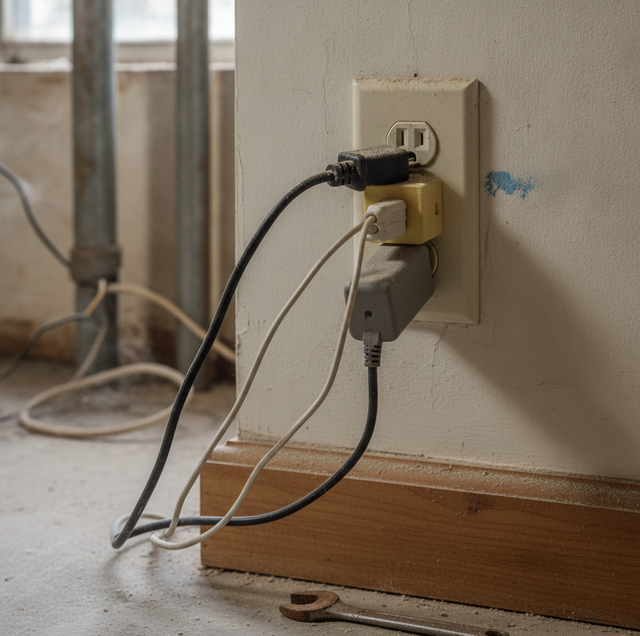
Walk through most homes built before the 1980s and count the receptacles in any given room. You will usually find one or two, sometimes a lone outlet on a whole wall. That was plenty when a household ran a lamp, a clock radio, and maybe a television. It is nowhere near enough for a room that now holds a TV, a soundbar, a game console, a couple of phone chargers, a laptop, and a lamp, all wanting power at once.
The wiring did not shrink. The demand grew around it. When there are too few outlets for the way you actually live, the shortage rarely announces itself as a shortage. It shows up as a pile of workarounds: the power strips, the extension cords, the little adapters that turn one plug into three. Those workarounds are the real signal, and some of them carry more risk than people realize.
Why Older Homes Run Short
Every circuit in your home is a loop of wire protected by a breaker, and that pairing was designed around an expected load. A mid-century bedroom circuit was never meant to feed a home office. The wire gauge, the number of receptacles, and the breaker size all reflected the appliances of the era.
The problem is not that old wiring is automatically bad. Much of it is fine for what it was built to do. The problem is the mismatch between then and now. A single wall outlet becomes the anchor point for a power strip; the strip fills up, someone adds an extension cord to reach the far corner, and suddenly, one receptacle installed for a lamp is carrying the current of a whole workstation.
Think of it like a two-lane road that was built for a quiet neighborhood. The road is not broken. It simply was not designed for rush-hour traffic, and when you force rush-hour volume onto it, you get congestion and heat. Outlets work the same way. Push more current through a circuit than it was planned for, and the wire warms, the breaker starts tripping, and the weakest link in the chain, often a cheap cord or an overloaded strip, is where trouble begins.
The Signs, One by One
Power strips and extension cords have become permanent: A power strip for a home theater setup is normal. A power strip that has lived behind the couch for three years, feeding devices you never unplug, is a sign that the wall does not have enough outlets. Extension cords are worse when they are permanent, because they are built for temporary reach, not for being a fixed part of your electrical system.
Cords are daisy-chained: This is a strip plugged into another strip, or an extension cord feeding a power strip feeding another cord. Each link adds resistance and another connection point that can loosen or heat up. Daisy-chaining concentrates a growing load onto a single upstream outlet that was never meant to serve more than one plug.
Cords run under rugs or across doorways: When a cord has to cross a room to reach a power source, the outlet is in the wrong place, or there are too few outlets. A cord in a walkway is a trip hazard, and a cord under a rug is a heat hazard, which the FAQ below covers in detail.
One outlet is split several ways: Those flat multi-outlet adapters and cube taps that turn one receptacle into three or six let you plug in more things, but they do nothing to increase what the circuit behind that outlet can safely deliver. They simply make it easier to overload it.
The breaker trips when several things run at once: Run the microwave, the toaster, and the coffee maker together, and the kitchen breaker cuts out. That is the circuit doing its job, telling you the combined draw is more than it was built for. A breaker that trips under a predictable combination of loads is pointing straight at a circuit that is stretched too thin.
Plugs or outlets feel warm: A plug or faceplate that is warm to the touch is a warning. Warmth means resistance and current are producing heat at that connection, whether from an overloaded circuit, a loose connection, or a worn receptacle. This one deserves attention sooner rather than later.
Rooms simply do not have enough: Kitchens with a single counter outlet, home offices with one receptacle behind the desk, and bedrooms with nothing near the nightstand. When the room's design fights the way you use it every day, the outlet count is the constraint.
Why It Matters More Than Convenience
It would be easy to treat all of this as an annoyance, a matter of tidiness. The reason it goes further is heat and where that heat hides.
Extension cords and power strips are rated for temporary use. Their conductors are thinner than the fixed wiring in your walls, and they are not built to run a heavy load continuously. Ask one to permanently feed a device that pulls a lot of current, and it can warm up beyond what it was designed to handle. Bury it under a rug or behind furniture, and the heat has nowhere to go, so it builds. That combination, a continuous load on a temporary cord in a spot where heat cannot escape, is a recognized way that household fires start.
Overloading a circuit does the same thing on a larger scale. Trip hazards from cords across a walkway are the more obvious danger, the kind that sends someone to the ground with an armful of groceries.
Older homes carry an extra wrinkle. Many were wired before ground-fault and arc-fault protection became standard, and a lot of them still have two-prong outlets with no ground path at all. That means the very rooms most likely to be short on outlets are often the same ones missing the safety features that newer wiring includes.
What Actually Fixes It
The right fix depends on whether you are short on outlets or dealing with a fault, and those are different problems. "I need more outlets" means the wiring works, but there are not enough places to plug in, which calls for adding receptacles or circuits. "This outlet stopped working" points to a fault, a loose connection, a tripped device, or damaged wiring, and that is a repair, not an expansion. It is worth knowing which one you have before you call, because the conversation is different.
For a genuine shortage, an electrician has a range of options:
Add receptacles to an existing circuit where that circuit has room to spare, so a wall goes from one outlet to several.
Run new dedicated circuits back to the panel for areas that need real capacity, such as a home office or a kitchen counter.
Replace two-prong outlets with grounded three-prong receptacles where a ground path exists, or install ground-fault protection where it does not, which is the accepted way to bring modern protection to older wiring.
Add specialty receptacles, including outlets with built-in USB ports or the kind of counter and island outlets that keep cords off the floor entirely.
Put high-draw appliances on their own circuit so a microwave or a space heater is not sharing a wire with everything else in the room.
One thing worth saying plainly: today's wiring rules call for far more receptacles in a room than mid-century construction ever provided. A room built decades ago met the standard of its day and can still feel short now, not because anything failed, but because expectations moved. That gap is exactly what these upgrades close.
All of this is licensed electrician work. Adding circuits, extending wiring, and swapping outlet types involves the panel and the wiring inside your walls, and it needs to be done by someone qualified. The do-it-yourself version of an outlet shortage is another power strip, and that is the path this whole article is about avoiding.
Frequently Asked Questions
Not as a substitute for a real outlet. Power strips and extension cords are rated for temporary use, and running a permanent appliance or a space heater through one can overheat the strip itself, not just the circuit. A strip is fine for a cluster of low-draw electronics you plug and unplug; it is the wrong tool for anything that draws heavily or runs around the clock. When a strip has become permanent, that is the signal that a fixed outlet belongs in that spot instead.
Because several devices on the same circuit draw more current than the breaker is rated for, the breaker trips to protect the wiring behind the wall from overheating. It is a safety device doing its job, not a nuisance. The real fix is spreading the load across more circuits so no single one carries everything, never simply installing a larger breaker. A bigger breaker on the same wire removes the protection without adding any capacity, which defeats the point.
A cord under a rug cannot shed the heat it produces, and it gets stepped on every time someone crosses the room. Over time, the pressure and flexing wear the insulation, and because it all happens out of sight beneath the rug, the warming and the damage build where no one can see them. That hidden combination of trapped heat and worn insulation is a common and preventable cause of house fires, which is why cords are meant to run in the open, not under floor coverings.
Often, yes. Depending on how the wall is built and what is nearby, an electrician can sometimes add a receptacle by tapping into a nearby circuit and fishing the new wire through the hollow cavity of the wall, which keeps the damage to a small opening or two. It is not always possible, and a brand-new dedicated circuit running all the way back to the panel is a more involved job, but a single added outlet is frequently less disruptive than homeowners expect.
Modern practice spaces provide receptacles so that no point along a wall is far from one, which results in far more outlets than older homes had. The idea is that you should be able to plug something in near where you are standing without reaching for a cord. A mid-century room can feel short on outlets precisely because it was built to an earlier, thinner standard, one that it met perfectly well at the time, before households filled every room with devices.
High-draw items are the candidates. A microwave, a window air conditioner, a space heater, or a home-office setup running several machines at once each pull enough current that they are better served by a circuit of their own rather than sharing with a room's general outlets. Giving a heavy load its own circuit keeps it from competing with everything else on the wire, which is what stops the breaker trips and the warm plugs that come from stacking big draws on one line.
Book an outlet and circuit assessment — get the receptacles and capacity your home actually needs. Zimmerman Electric Company serves Redondo Beach, Torrance, and Manhattan Beach. Call (310) 378-1323.