
Why Do My LED Lights Buzz or Flicker on a Dimmer?
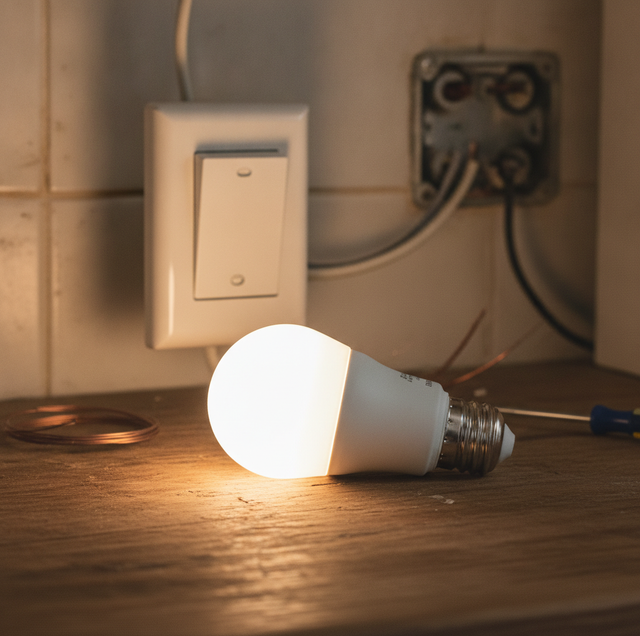
You put in energy-saving LED bulbs, reach for the dimmer, and instead of a clean fade, you get a wavering flicker, a faint hum, or a buzz you can hear from across the room. Sometimes all three at once. It is one of the most common complaints after switching to LEDs, and it is almost never a defective bulb. What you are hearing and seeing is a mismatch between how your dimmer delivers power and how an LED expects to receive it.
The good news is that once you know what the mismatch is, the fix is a matter of pairing the right parts. Here is what causes it and how to get quiet, even dimming.
It's a Compatibility Mismatch, Not a Bad Bulb
Most dimmers already in a home were built for incandescent bulbs. An incandescent draws a lot of power and dims by having its voltage trimmed back, so it tolerates a rough power signal without complaint. An LED does the opposite. A bulb that once pulled 60 watts as an incandescent might draw 8 or 9 watts as an LED, a fraction of the load the old dimmer was designed to see. That dimmer still chops the AC waveform on and off many times a second to dim, but now it is feeding that chopped-up power into an LED's tiny driver circuit, which was never meant to smooth out such a rough signal at such a low load.
Two things fall out of that. The waveform the LED receives is uneven, so the light output wavers as a flicker. And the fast electrical switching sets small internal parts vibrating, which you hear as a buzz. The bulb is fine, and the dimmer works; they were simply never designed to speak to each other.
| Symptom | What's behind it |
|---|---|
| Flicker, worst when dimmed low | The chopped waveform of the LED driver can't smooth |
| Audible hum or buzz | Magnetic parts vibrating at the switching frequency |
| Won't dim the bottom third of the range | Too little load for the dimmer to hold steady |
| Only some bulbs act up | A non-dimmable or mismatched bulb in the mix |
Match a Dimmable Bulb to an LED-Rated Dimmer
The fix comes down to pairing two parts correctly.
Start with the bulb. Not every LED can be dimmed at all, so check the package for the word "dimmable." A bulb that does not carry that label has no dimming circuitry inside and will flicker, drop out, or refuse to dim, no matter which switch it is on.
Then look at the dimmer. Older dimmers made for incandescent loads are what most homes still have on the wall, and they often will not run a low LED load cleanly. A dimmer built and labeled for LEDs is designed to control that small load smoothly across the full range. Pairing a bulb marked "dimmable" with a dimmer rated for LEDs settles the large majority of buzzing and flickering cases on its own. Keeping every bulb on that circuit the same make and model matters too, because the dimmer holds a single, even setting, which is far better when it is driving identical loads than when it is juggling bulbs that each behave a little differently.
If you have matched the right parts and a stubborn flicker or hum still lingers, that is usually where a dimmer's low-end trim adjustment or its minimum-load rating comes into play, and where having an electrician pick and dial in the switch for your specific fixtures saves a lot of trial and error.
Frequently Asked Questions
It traces back to load. Old dimmers were engineered for high-wattage incandescent bulbs, and an LED replacement draws only a small fraction of the current that the dimmer expects to see. Below the load the switch was designed for, its chopping of the AC waveform gets ragged, and that ragged, low-current signal is what the LED's small driver cannot turn into a steady, quiet light. The mismatch is between a high-wattage-era switch and a low-wattage bulb.
Older dimmers are usually leading-edge, sometimes called TRIAC dimmers, and they cut the power at the start of each AC half-cycle. That abrupt cut is hard on an LED's driver and tends to be the type that produces buzz and flicker. Trailing-edge dimmers, also labeled ELV, cut power at the end of the half-cycle instead, which is a gentler waveform that an LED driver handles far more cleanly. For LED lighting, a trailing-edge or ELV dimmer is generally the better match.
They come from two different parts of the same problem. The flicker is the light responding to the shape of the chopped waveform, so you see it in the brightness. The buzz comes from magnetic components inside the bulb or from the dimmer physically vibrating as the current switches on and off dozens of times a second, which is why you hear it. That is why one fixture can hum without any visible flicker, and another can flicker silently.
Mixing bulbs is a common culprit. If the bulbs on one dimmer are not all the same make and model, or a non-dimmable bulb slipped in among dimmable ones, the dimmer is trying to hold one setting across loads that each react differently, and the odd ones out flicker. Swapping the whole set to a single dimmable model usually clears it up faster than chasing one bulb at a time.
That points to a minimum-load problem. Many dimmers require a certain amount of wattage on the circuit to run reliably, and a couple of low-wattage LEDs may fall below that threshold, so the dimmer can't maintain a clean signal at the bottom of the range. A small minimum-load resistor, sometimes sold as a dimmer adaptor, wires into add the load the dimmer wants to see and can stop the flicker without adding meaningful brightness.
Check two things on the dimmer. First, it's the LED compatibility chart. Dimmer makers publish lists of which bulbs have been tested to dim smoothly on that model, and matching your bulb to that chart takes the guesswork out. Second, its maximum LED wattage rating is often much lower than the rating for incandescent, so you stay under the ceiling the manufacturer specifies for LED loads. Between the chart and the LED wattage limit, you can confirm the pairing before anything goes on the wall.
Getting a Clean, Quiet Fade
Buzzing and flickering LEDs on a dimmer come down to a load and waveform mismatch between a bulb built to sip power and a switch built to feed a lot of it. Pair a bulb marked "dimmable" with a dimmer rated for LEDs, favor a trailing-edge or ELV type, keep every bulb on the circuit identical, and check the dimmer's compatibility chart and LED wattage limit before you commit. Get that pairing right, and the lights fade the way they were supposed to: even, silent, all the way down.
If your LED lights buzz or flicker on the dimmer, we can match the bulbs and dimmer for smooth, quiet dimming. Zimmerman Electric Company serves Redondo Beach, Torrance, and Manhattan Beach. Call (310) 378-1323.