
Recessed vs. Track Lighting: Which One Wins Your Room?
QUICK ANSWER: Recessed lights sit flush in the ceiling and throw a clean, even wash of ambient light, so they suit low ceilings, open rooms, and a minimal look, but they need a ceiling cavity and are hard to reposition later. Track lighting mounts on the surface and carries adjustable heads you can aim, so it wins for accenting art, lighting a kitchen work zone, or covering a concrete or no-attic ceiling where you cannot cut cans in. Many rooms use both.
You stand in a half-renovated room, hand on the switch, trying to decide what the ceiling should look like for the next fifteen years. Two very different answers are staring back at you. One disappears into the drywall and lights the whole space so evenly you forget the fixtures exist. The other rides on the surface, unmistakably present, with heads you can twist toward whatever you want to show off. Recessed and track lighting solve overlapping problems in opposite ways, and picking wrong is expensive to undo. What follows is how each one behaves and how to match it to the room you actually have.
What Recessed Lighting Is
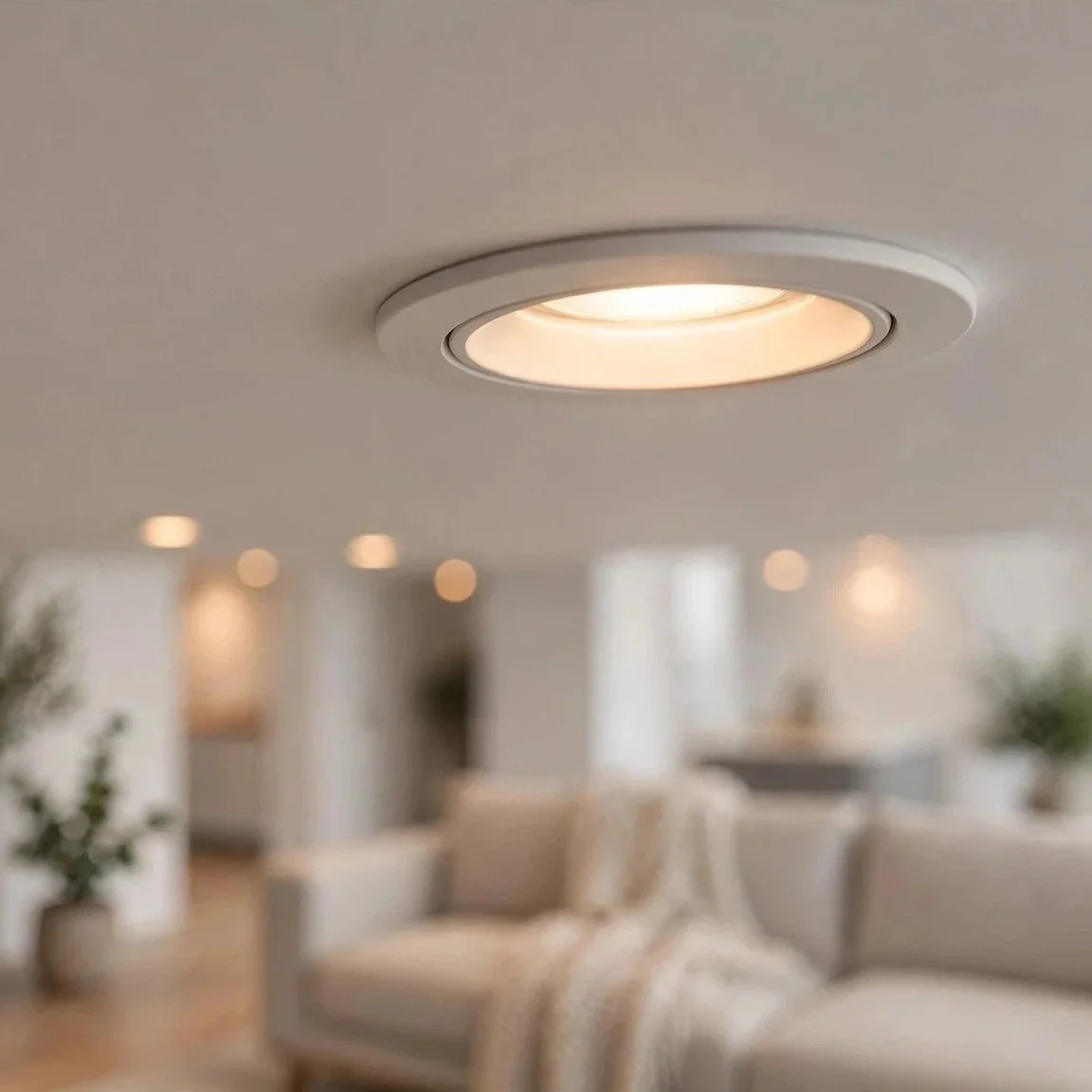
Recessed lighting, often called can lights or downlights, installs into a housing set inside the ceiling so the trim finishes flush with the drywall. From below, you see a clean circle of light and almost no hardware. Because the fixture lives above the ceiling plane, nothing hangs into the room, which is why designers reach for it when they want the light to feel architectural rather than added on.
That flush mounting is the whole appeal. A grid of recessed lights lays down a broad, even wash across a room with no fixture competing for attention. Ceilings read taller because nothing drops below them. In an open-plan space, recessed cans keep the sightlines calm from one zone to the next.
The trade is access and permanence. Each can needs a pocket of space above the ceiling, and it needs wiring routed to it, so recessed lighting is far easier to install where there is an accessible attic or an open joist bay than in a finished ceiling with a floor above. Once a can is cut in and wired, it points one direction. Repositioning it later means patching drywall and running new cable, so recessed layouts reward upfront planning over changing your mind later.
Where a recessed can sits against attic insulation, it must be an IC-rated insulation contact housing. A non-IC fixture buried in insulation traps its own heat and becomes a fire hazard, which is one reason the placement and rating of recessed cans is not a guess to make from the ground.
What Track Lighting Is
Track lighting takes the opposite approach. A powered rail mounts to the surface of the ceiling, and individual light heads clip onto that rail wherever you want them. Each head pivots and rotates, so you aim light instead of just dropping it straight down. Add heads, remove them, or slide them along the track as the room changes.
Because the track sits on the surface, it needs only a single power feed at one point rather than a wired pocket above every fixture. That makes it the practical answer for ceilings you cannot easily cut into: a concrete ceiling, a room with living space directly above and no attic, or a finished ceiling where fishing cable to a dozen cans would mean tearing it open.
The flexibility is the point. Track heads excel at accent and directional light, washing a gallery wall, grazing a textured surface, or throwing pooled light onto a kitchen counter or island exactly where hands work. The cost of that flexibility is visibility. The rail and heads are part of the room's look, not hidden, so track reads as a design feature you either want on display or you do not.
How To Choose Between Them
The decision is less about which is better and more about what your ceiling allows and what job the light has to do. A few drivers settle most rooms.
Ceiling access and cavity: This is the first gate. Recessed cans need depth above the ceiling and a way to route wire to each one. An accessible attic makes that reasonable. A concrete slab, a low plenum, or an occupied room above tilts you hard toward track, which asks for one feed and rides on the surface.
Ceiling height: In a low room, anything that hangs down eats headroom and draws the eye to the ceiling. Recessed lights preserve the height because they vanish into the plane. On a tall or vaulted ceiling, surface-mounted track is barely noticed from below and buys you aiming control you would otherwise lose.
The job the light must do: Even ambient fill across a whole room is recessed lighting's native strength. Pointing light at specific things- art, shelving, a backsplash, a work surface- is track's. Many rooms want both: recessed cans for the general wash and a short track to accent the features that deserve it.
Aesthetics: Recessed disappears; track declares itself. A minimal, built-in look leans recessed. A room where visible, adjustable fixtures suit the style, or where you actively want to reposition light season to season and year to year, leans track.
Wiring and the new circuit: Both may need a dedicated circuit or a new run from the panel, and either way the layout, spacing, load, and connection are licensed-electrician work. Recessed spacing that is too wide leaves scalloped dark bands between cans; too tight wastes fixtures and washes the room flat. Track feed placement determines where every head can reach. These are design calls a pro makes before anything gets cut, not after.
A Kitchen And A Gallery, Side By Side
A restaurant kitchen and an art gallery ask for opposite ceilings, and the reason maps cleanly onto this choice. The kitchen wants steady, shadow-free light over the whole prep area so no counter sits in a dim pocket, which is recessed lighting's even wash doing exactly what it does best. The gallery wants each piece lit on its own terms, one canvas brighter, the next angled differently, the wall between them left calm, which is a row of aimable track heads doing what recessed cans physically cannot. Your rooms usually contain a bit of both jobs: a broad space that wants uniform fill and a few features that want a spotlight.
Dimming And LED Considerations
Nearly all recessed and track lighting sold now is LED, and LEDs change what dimming asks of the system. An LED head or can draws far less power than the old halogen or incandescent it replaced, and many wall dimmers were built for those heavier loads. Pair a low-wattage LED array with a dimmer meant for a big incandescent load, and you can get flicker, buzz, a narrow usable dimming range, or lights that will not go fully dark. The fix is matching an LED-compatible (often labeled ELV or specified for the fixture) dimmer to the actual heads, and confirming the fixtures themselves are marked dimmable, since not all are.
Color temperature matters as much as brightness. A warmer output suits living and dining spaces; a cooler, crisper output suits work zones and detailed tasks. Some fixtures let you select the temperature at install. Mixing temperatures carelessly across one open room makes the space read patchy, so this is worth deciding deliberately rather than by whatever was on the shelf.
For track specifically, the heads on a single rail typically dim together on one control, so if you want separate scenes for accent and general light, that usually means separate circuits or a track system built for zoning. Sorting this out before the walls close is far cheaper than rewiring after.
Why Layout And Wiring Belong To A Pro
It is tempting to treat lighting as a finish-level, cosmetic choice, and the fixtures themselves are the fun part. The parts that decide whether the result looks intentional or amateur, and whether it is safe, sit behind the drywall. Recessed can spacing, beam spread, and distance from walls determine whether you get a smooth wash or a row of dark scallops. IC-rating and clearance from insulation and framing determine whether a hot fixture is safe above the ceiling. Circuit sizing, load, and the connection at the panel are licensed work by definition, not a project to wire yourself. A qualified electrician sizes the layout to the room, specifies fixtures that dim the way you expect, and makes every connection to code, which is the difference between lighting you stop noticing because it simply works and lighting that annoys you every evening.
Frequently Asked Questions
Yes, using low-profile or canless LED recessed units built for that situation. These wafer-style fixtures carry a remote driver box that tucks through the same small opening, so they need only about half an inch of clearance instead of a full can housing. That makes them workable in a ceiling with living space directly above where a traditional can would never fit, though the electrician still has to reach the opening to route power.
A common rule of thumb divides the ceiling height by two to set the spacing between cans: a nine-foot ceiling suggests roughly four to four-and-a-half feet between fixtures for an even wash. Cans set nearer the walls, usually around two to three feet off, light the vertical surfaces and stop the room's edges from going dark. The exact numbers shift with the beam angle of the trim chosen.
Yes, and it catches people out. The common standard rails, often called H, J, and L types after their original makers, use different connector geometry, so a head built for one will not seat on another. Buying heads and rail from the same system, or confirming compatibility before you order, avoids ending up with fixtures that physically will not mount.
Rarely on its own for a room used for varied tasks. Good lighting design layers three types: ambient (the general fill), task (bright light where you work), and accent (highlighting features). Recessed handles ambient well and track handles accent well, but a room that leans on only one layer tends to feel either flat or spotty, which is why the strongest rooms combine layers rather than a single fixture type.
An airtight (AT) housing is sealed so conditioned air cannot leak up through the fixture into the attic, and it is worth specifying anywhere the ceiling separates living space from an attic, most of all under spray foam that relies on a tight air barrier. Older non-sealed cans can leak a surprising amount of air around the trim and the bulb socket, which shows up as higher heating and cooling costs and, in cold weather, as frost or condensation forming at the fixture. Gasketed AT trims and canless LED units carry the rating on the label, so it is worth checking before you buy rather than after the ceiling is closed up.
Track heads themselves usually pull off and clip back onto a de-energized rail easily, which is part of the track's appeal for changing a room over time. Swapping a recessed trim or a bulb is also simple. What is not a swap is moving where the light is, adding a new run, or changing the circuit, since anything touching the wiring past the fixture connection is licensed work for safety and code reasons.