
Whole-House Surge Protector: Do You Actually Need One?
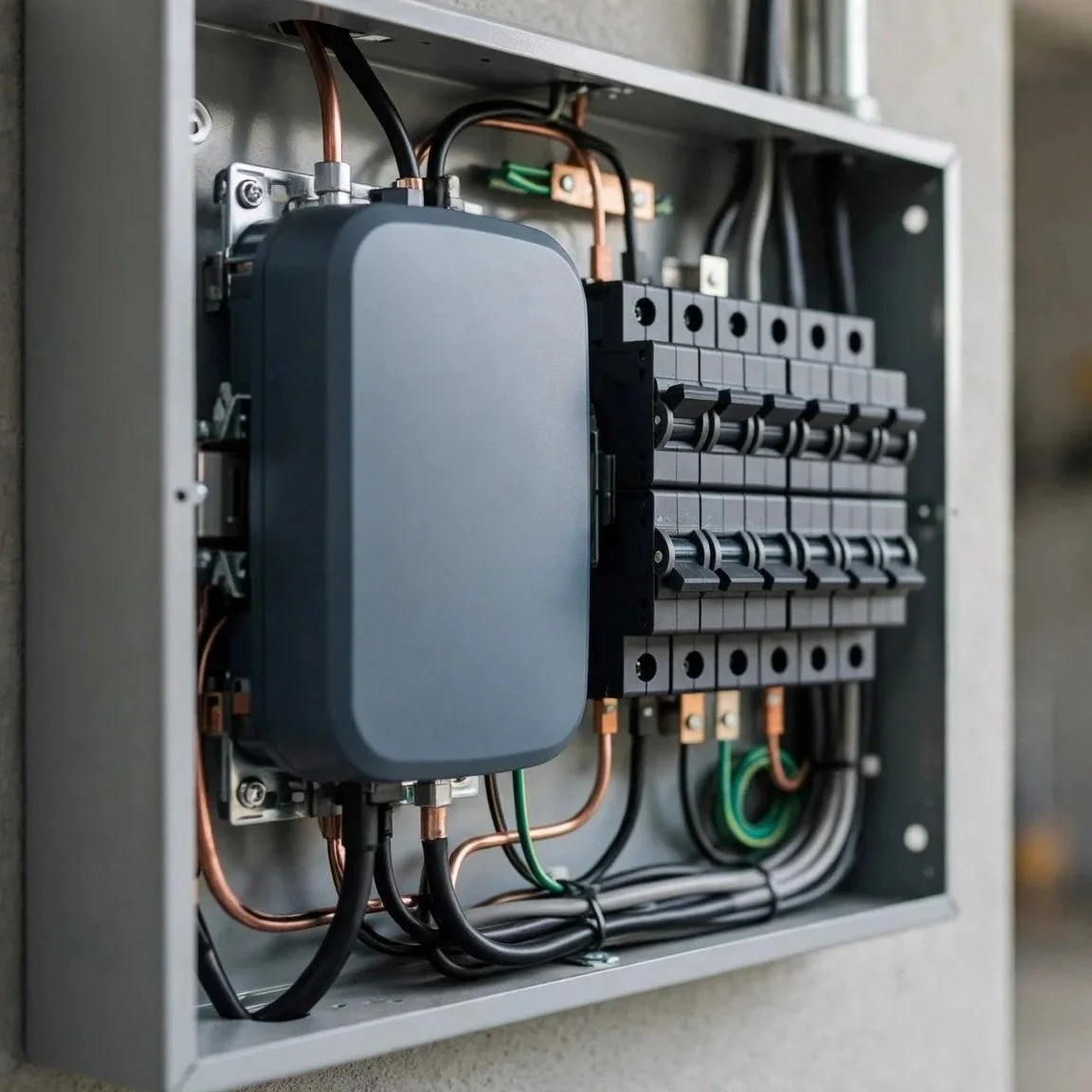
A surge is a brief spike in voltage that pushes far above the roughly 120 volts your outlets normally deliver. It can last only a few millionths of a second, but in that instant the extra pressure forces its way into whatever is plugged in, cooking the delicate parts inside a circuit board or slowly degrading a motor winding. A whole-house surge protective device, or SPD, sits at the electrical panel and watches for those spikes. The moment voltage climbs past a safe threshold, the device shunts the excess energy to the ground wire before it fans out across your branch circuits. In plain terms, it catches the flood at the front door instead of letting it soak every room.
That single placement is what separates a panel SPD from the plug-in strip behind your TV. The strip guards one location. The panel unit guards the whole service, so the furnace control board, the garage door opener, the hardwired oven, and every outlet get the same first line of defense.
QUICK ANSWER: A whole-house surge protector is a device wired into your main electrical panel that clamps large voltage spikes and diverts them to ground before they reach your circuits. Most homes with modern electronics and appliances benefit from one, though it works best paired with plug-in protectors at sensitive equipment.
Where Surges Actually Come From
The mental image most people carry is a lightning bolt hitting a pole down the street. Lightning does cause surges, and those are the most violent, but they are also the rarest. The larger share of the spikes hitting your wiring never come from the sky at all.
External surges originate on the utility side. When the power company switches loads between substations, or when a grid substation trips and reconnects, it can send a momentary jump down the service line into your panel. Downed lines, tree contact, and a neighbor's large equipment can do the same. These arrive without warning and have nothing to do with the calendar.
Internal surges are the quiet majority. Studies of household power quality generally attribute most surge activity to sources inside the home. Every time a large motor cycles off, the collapsing magnetic field releases stored energy back into the wiring as a voltage spike. The air conditioning compressor, the refrigerator, a well pump, the pool pump, a garbage disposal, even a laser printer's heater all contribute. These small spikes happen dozens of times a day, every day of the year, and they slowly wear down the electronics sharing your circuits. This is the year-round reality a surge device is built for, not a seasonal one.
How a Panel SPD Clamps and Diverts a Spike
Inside the device is a component that behaves like a pressure relief valve for electricity. At normal voltage, it does almost nothing and lets current pass by untouched. When voltage crosses the device's clamping point, its internal resistance drops in a fraction of a microsecond, opening a low-resistance path that carries the surge energy sideways into the grounding system rather than onward to your circuits. Once the spike passes and voltage falls back to normal, the component returns to its high-resistance idle state. The most common part doing this work is a metal oxide varistor, or MOV, and better units stack several so they share the load and last longer.
Type 1 Versus Type 2: The two categories you will see refer to where the device is allowed to connect.
A Type 1 SPD is rated to install on the line side of the main breaker, ahead of the panel's main disconnect, and it handles the highest-energy events, including a nearby lightning strike. It is often the choice when a home sits on an exposed service.
A Type 2 SPD installs on the load side of the main breaker, inside the panel next to the branch breakers, and handles the switching and internal surges that make up everyday activity. For most homes, a Type 2 unit at the main panel is the workhorse, and many models are listed for either position.
Both do the same core job. The difference is how much energy they are built to absorb and where the wiring rules permit them to sit.
Why Layering Beats a Single Device
A panel SPD is powerful but blunt. It stops the big incoming spikes, yet the wiring between the panel and a far outlet acts like a small spring, and a little of the surge energy can still ring through by the time it reaches sensitive gear. The panel unit also does nothing about a spike generated by an appliance already downstream of it.
Pairing the panel device with point-of-use protectors closes both gaps. The panel handles the heavy hits at the service entrance, and a quality strip or receptacle protector at the media center, the home office, or the gaming setup mops up whatever slips through and catches spikes born on that same circuit. Electricians describe this as a layered or cascaded approach, and it is the arrangement that actually keeps a modern television or a computer alive over years of small daily insults.
Reading the Spec Sheet Without the Jargon
Two numbers matter most when comparing units, and both are simpler than they look.
Joule rating is a measure of how much surge energy the device can absorb over its life before it wears out. Think of it as the size of the sponge. A higher joule rating means the unit can soak up more, and more often, before it is spent. Panel-level devices carry ratings far above what a countertop power strip offers.
Clamping voltage, sometimes shown as the voltage protection rating, is the level at which the device kicks in and starts diverting. A lower clamping voltage means it acts sooner and lets less of the spike through to your equipment. There is a balance here: clamp too aggressively and normal fluctuations trip it; clamp too high and more energy reaches the gear you wanted to protect. Manufacturers publish these figures, and a lower let-through number is the one to favor for sensitive electronics.
What a Surge Device Does Not Do
A surge protector has a narrow job, and it helps to know its limits so you are not caught relying on it for the wrong thing.
It does not replace grounding: The device works by throwing surge energy onto the grounding system, so it needs a solid, code-compliant ground to have somewhere to send that energy. A surge unit bolted onto a poorly grounded panel is largely decorative. Grounding is the foundation the protection stands on, not something the SPD provides.
It does not act as a battery backup: When the power goes out or dips into a brownout, an SPD does nothing to keep your equipment running. That is the job of an uninterruptible power supply, a UPS, which carries a battery and rides through outages so a computer or a medical device does not blink off. A surge protector guards against too much voltage; a UPS guards against too little or none. A well-set-up home office often uses both.
It also will not fix chronically low voltage, flickering caused by loose connections, or an overloaded circuit. Those are wiring problems that need diagnosis, not a device at the panel.
The Indicator Light and Knowing When It Is Spent
Because the internal parts sacrifice themselves absorbing energy, a surge device does not last forever. Each large spike, and the steady drip of small ones, uses up a little of that joule capacity. Eventually the protection is exhausted, and here is the part homeowners miss: a spent unit still passes power normally. Your lights and outlets keep working, so nothing tells you the protection quietly died.
TIP: Nearly every panel surge device carries a status indicator, usually a green light or a small window. Green means the protection is live, and when it turns red, goes dark, or sounds an alert, the internal components are spent, and the unit needs replacement even though power still flows normally. Glance at that indicator after any major electrical event in the area.