
GFCI vs. Standard Outlets: The 6-Milliamp Difference
QUICK ANSWER: A GFCI outlet senses tiny current leaking to ground and cuts power in a fraction of a second, so it protects people from shock in wet or grounded areas: kitchens near the sink, bathrooms, garages, basements, crawl spaces, laundry, outdoors, and anywhere near water. A standard outlet has no such sensing and is fine in dry living areas like bedrooms and hallways.
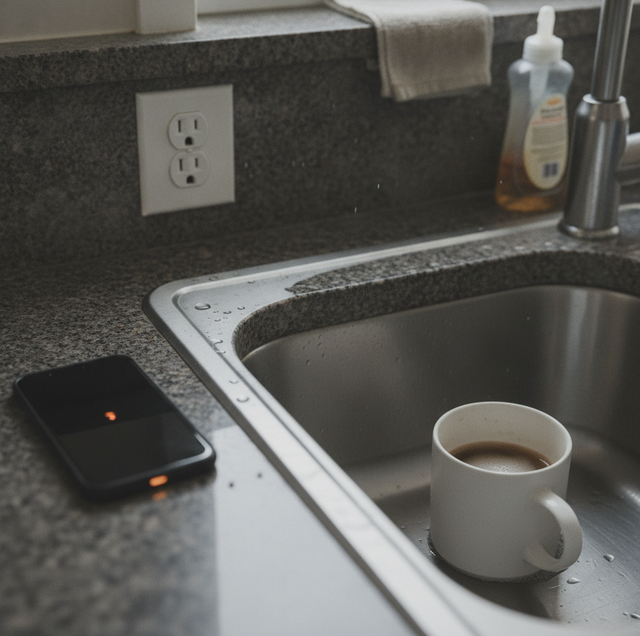
You are rinsing a coffee mug at the kitchen sink, phone charging on the counter a foot away, hands dripping. If a frayed cord or a cracked charger sent stray current through that puddle and into you, what stands between the wet counter and a hospital visit? On most counters near a sink, the answer is a small outlet with two little buttons marked TEST and RESET. That outlet is doing math you never see, and understanding what it does (and where it belongs) changes how you look at every receptacle in the house.
What A GFCI Actually Senses
A standard outlet is a passive connection. It hands over power on demand and asks no questions. The only thing watching that circuit is the breaker back at the panel, and the breaker is looking for one thing: too much current flowing at once, the kind that comes from a dead short or an overloaded circuit. A typical household breaker sits at 15 or 20 amps. It has to let normal appliance loads through, so it does not react until current climbs into the range of thousands of milliamps.
Here is the problem with that, as your only line of defense. It takes very little current through a human body to be dangerous. Current in the range of just tens of milliamps across the chest can lock your muscles or throw off your heart rhythm. That is a fraction of a percent of what the breaker is waiting for. By the time enough current flows to trip a 15-amp breaker, a person in the path has been receiving a fatal dose for far too long. The breaker protects the wire in the wall. It was never designed to protect the person touching the appliance.
A GFCI, ground-fault circuit interrupter, solves a different problem with a different method. Inside it, a sensor continuously compares the current flowing out on the hot wire against the current returning on the neutral. In a healthy circuit, those two numbers match almost exactly: everything that leaves comes back. When current starts leaking to ground through an unintended path, through a wet cord, a failing motor, or a person standing on a damp floor, some of it no longer returns on the neutral. The out and the back stop matching. The moment that imbalance reaches roughly 4 to 6 milliamps, the GFCI snaps the circuit open, typically in a fraction of a second.
Think of it like a tollbooth that counts every car onto a bridge and every car off it. As long as the counts match, traffic flows. The instant one car vanishes mid-span (leaking off through some path it should not have taken), the booth slams the gate. The GFCI does not care how big the total load is. It cares only that what goes out comes back. That is why it can catch a leak thousands of times smaller than what a breaker reacts to, and catch it fast enough to matter.
So the core split is simple. GFCIs protect people from shock in places where water and grounded surfaces are close. Standard outlets are fine in dry areas where shock risk is low. Neither replaces the breaker; the breaker still guards against overloads and shorts on both.
Where GFCI Protection Is Called For
Water and grounded metal are what turn a minor fault into a shock, so GFCI protection follows moisture and earth contact around the house. Building codes have expanded these locations over the decades, and modern practice (the standard a professional will bring your work up to during a remodel) puts GFCI protection in these spots:
Kitchens: counter outlets serving the countertop, especially the ones flanking the sink, plus island and peninsula receptacles.
Bathrooms: every receptacle, because you are routinely wet and often touching grounded fixtures.
Garages: concrete floors and damp tools make these grounded, unpredictable spaces.
Unfinished basements: bare concrete and higher humidity.
Crawl spaces: at or below grade, often damp.
Laundry areas: the washer, the sink, and the risk of standing water.
Outdoors: any exterior receptacle, on the porch, the patio, the driveway, the eaves.
Near pools, spas, and hot tubs: water and bare skin, the highest-risk case of all.
Wet bars and utility sinks: outlets within a few feet of the basin.
The pattern behind the list is worth holding onto: if a plugged-in device and a person could plausibly share a path to ground through water, that outlet wants GFCI protection.
| Location | Protection needed | Why |
|---|---|---|
| Kitchen counter near sink | GFCI | Water plus grounded sink and appliances |
| Bathroom | GFCI | Wet skin, grounded plumbing fixtures |
| Garage/workshop | GFCI | Concrete floor, damp tools |
| Unfinished basement, crawl space | GFCI | Bare concrete, higher humidity |
| Laundry/utility sink | GFCI | Standing water, nearby basin |
| Outdoor/patio/pool area | GFCI | Rain, hoses, wet ground, bare skin |
| Bedroom, living room, hallway | Standard is fine | Dry, low shock risk |
| Dining room, home office (dry) | Standard is fine | No water, no earth-contact path |
That last group matters as much as the first. GFCIs are protection, not decoration, and there is no safety reason to blanket a dry bedroom in them. Standard outlets belong in dry living spaces; GFCIs belong where the water is.
In salt-air environments specifically, there is a local wrinkle that raises the stakes on the outdoor half of that list. Salt air is corrosive. It works on the metal contacts inside outdoor receptacles, and their weatherproof covers, and corroded contacts are exactly the kind of high-resistance, leaky connection a GFCI is built to catch. Damp marine air also keeps exterior surfaces conductive longer than they would be inland. A working GFCI on your patio and exterior outlets is not a formality in these conditions; it is compensating for an environment actively trying to degrade the connection.
The Three Ways To Get GFCI Protection
GFCI is a function, not a single product. You can deliver that function to an outlet in three ways, and knowing the difference helps explain a puzzle many homeowners run into: the outlet with no buttons that still trips.
A GFCI receptacle: This is the familiar outlet with TEST and RESET buttons built into its face. The sensing electronics live inside that device, protecting anything plugged directly into it.
A GFCI breaker: Here, the sensing lives back at the panel, in a special breaker that protects the entire circuit it feeds. Every outlet on that circuit is protected, and there are no buttons on the outlets themselves; the TEST and RESET are on the breaker in the panel.
A downstream outlet fed by an upstream GFCI: A single GFCI receptacle can be wired to protect ordinary-looking outlets further down the same circuit. This is why one GFCI in your bathroom might also be protecting the outlet in a second bathroom, or on the exterior wall behind it. Trip the one with buttons, and the plain ones go dead too. That is not a fault, it is the design working as intended, and it is the most common reason a "dead" outlet with no buttons comes back to life once you find and reset the GFCI it answers to.
One protected device covering several outlets downstream is efficient, but it has a catch: it makes troubleshooting counterintuitive. When an outlet with no buttons quits, the reset you need may be in another room entirely. Anything involving the panel or the wiring behind these devices is work for a licensed electrician, not a live-panel DIY project. The point here is to understand the system, not to open it up.
GFCI Is Not AFCI, And Neither Is A Surge Protector
Three protective devices get confused constantly, and they do very different jobs. A GFCI watches for current leaking to ground and protects people from shock. An AFCI, arc-fault circuit interrupter, watches for the erratic electrical signature of arcing, the sparking that a damaged cord or a loose connection throws off inside a wall, and it is aimed at preventing fires rather than shocks. Modern codes call for AFCI protection in many living areas, bedrooms, and similar rooms, precisely where GFCIs are not required. Some devices, called dual-function breakers, combine both.
A surge protector is a third thing entirely. It clamps down on voltage spikes to protect your electronics from damage. It does nothing about shock and nothing about arcing. None of the three is a substitute for another; they guard against different failures, which is why a fully protected home uses more than one.
Frequently Asked Questions
Code generally applies to new work, not retroactively to existing wiring, so an older home is usually not forced to retrofit simply because the rules changed. The practical trigger is a remodel: when a kitchen or bathroom is opened up, or a circuit is extended or replaced, that work is typically brought up to current standards, which means GFCI protection where the list above calls for it. Outside of a remodel, adding GFCIs to wet-area outlets is a voluntary safety upgrade, and it is one of the higher-value ones in a house built before these protections were common.
Yes, and this is one of the most useful things a GFCI does. Older homes often have two-prong outlets with no ground wire in the box. A GFCI provides shock protection by comparing hot and neutral currents; it does not need a ground wire to sense a leak and cut power. That makes it a code-recognized way to replace an ungrounded two-prong outlet with a grounded three-prong outlet that opens safely. The catch is labeling: an outlet protected this way must be marked "No Equipment Ground," because while you are protected from shock, sensitive equipment that actually relies on a ground connection still does not have one.
The electronics inside a GFCI can fail silently, leaving an outlet that looks normal but no longer protects you. The TEST button deliberately creates a small fault so you can confirm the device still trips; RESET restores power afterward. A common manufacturer recommendation is to test monthly, press TEST, confirm the power cuts, then press RESET. If pressing TEST does not kill the power, or RESET will not hold, the device has failed and needs replacement. A GFCI that will not reset is often trying to tell you it caught a real fault or has reached the end of its service life.
Both sense the same hot-versus-neutral imbalance; they differ in where the sensing sits. A GFCI outlet puts protection and its reset button right at the point of use, which is convenient when a trip is likely, and you want to reset it without walking to the panel, a single bathroom, or an exterior outlet, for example. A GFCI breaker protects an entire circuit from the panel and is often the cleaner choice when many outlets on one circuit all need protection, or when the outlet locations are hard to reach. The trade-off is reset distance: a breaker trip sends you to the panel, while an outlet resets on the wall. An electrician sizes the choice of how the circuit is laid out.
No. A GFCI stops shocks by catching current leaking to ground. An AFCI helps prevent fires by catching the erratic arcing of damaged wiring or loose connections, and it is typically required in bedrooms and living areas rather than wet zones. A surge protector limits voltage spikes to shield electronics and does nothing for shock or arc protection. They are complementary, not interchangeable, and dual-function breakers exist specifically to combine GFCI and AFCI protection on one circuit where code calls for both.
Motors like the compressor in a refrigerator or freezer produce small, normal amounts of electrical noise and momentary leakage as they start and stop, and an older or sensitive GFCI can read that as a fault and trip. The consequence is not a safety failure but a practical one: a GFCI that nuisance-trips overnight can shut off a freezer and quietly spoil a fridge full of food before anyone notices. Where a refrigerator or freezer sits in a location that requires GFCI protection, such as a garage, the usual answer is a dedicated single-outlet circuit and a GFCI known to tolerate motor loads, so protection and reliability both hold. An electrician can assess whether a repeat-tripping appliance circuit is nuisance tripping or flagging a genuine fault worth fixing.
Have an electrician map which outlets need GFCI protection and test the ones you already have — so the wet-area receptacles that guard your family actually work when it counts. Zimmerman Electric Company serves Redondo Beach, Torrance, and Manhattan Beach. Call (310) 378-1323.