
Bathroom Heat Lamp Tripping the Breaker? Read When It Trips
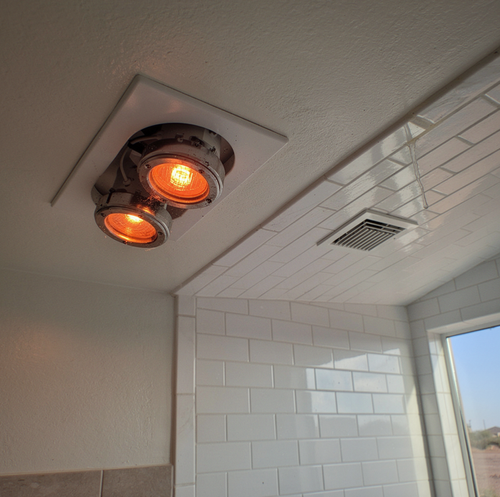
A bathroom heat lamp may run on the same circuit as a hair dryer, a vanity light, and an exhaust fan, and how quickly the breaker guarding that circuit trips separates an overload from a fault. That timing, plus what else was running when the power dropped, narrows the cause before anyone takes the grille down. Each trip pattern pairs with a likely cause:
| When it trips | What it points to |
|---|---|
| The moment the lamp switches on | A short at a socket or in the housing wiring, or a ground fault |
| After the lamp has run for several minutes | An overload heating the breaker's thermal element, or a loose connection warming the circuit |
| Only with the hair dryer or another load running | Combined draw passing the circuit's rating |
| A GFCI trips during or just after a shower | Moisture giving current a leakage path inside the fixture |
| The breaker is warm, or trips with nothing else on | A worn breaker, a poor connection at its terminal or panel clip, or a fault in the fixture itself |
How Much Current Heat Lamps and Fan-Heat-Light Units Draw
Current is watts divided by volts. A standard infrared heat lamp bulb is rated at 250 watts, which comes to a little over 2 amps at 120 volts. A fixture that holds two of those bulbs draws just over 4 amps. A combo unit pairing an exhaust fan and a light with a resistance heating element is a much heavier load: on some models the heater section alone is rated at 1,300 to 1,500 watts, or roughly 11 to 12.5 amps, before the fan and the light add their share.
A 15-amp circuit at 120 volts carries 1,800 watts at its rating, and a 20-amp circuit carries 2,400. A handheld hair dryer on its high setting can draw up to 1,875 watts, about 15.6 amps. Add a two-bulb heat lamp and that dryer on one 20-amp circuit, and the total comes to 2,375 watts, just over the rating by 25 watts. Switch on the vanity light, and it is over. Pair a 1,500-watt heater section with the same dryer and the draw is about 28 amps, far past what a 20-amp breaker will hold.
In some bathrooms, the lights, the fan unit, and the receptacles all feed from one circuit; in others, the ceiling unit has its own breaker. That layout decides whether a hair dryer can trip the lamp's breaker at all. On separate circuits, it cannot, and a trip on the lamp's circuit has to come from the lamp, its wiring, its breaker, or another load sharing that circuit.
Overload, Short or Ground Fault: What the Timing Says
The general causes of a tripping breaker apply to any circuit; what sets a heat lamp apart is how hot the fixture runs and how wet its room gets.
A household breaker carries two trip mechanisms in one case. A bimetal strip responds to heat from sustained current, and the further the load runs past its rating, the faster the strip bends enough to release the latch. A small overload can run for minutes first. A magnetic coil responds to a sudden surge, the kind a short produces, and opens the circuit almost instantly. A heat lamp breaker that holds for a while and then drops behaves like an overload; one that snaps off as the wall switch closes is reacting to a fault.
A short on a heat lamp circuit means a hot conductor has reached a neutral with almost nothing in between: a cracked socket, a fixture lead whose insulation has baked brittle and split against the metal housing, a stray strand bridging two terminals. A ground fault is the same current reaching the metal housing, the ground wire, or a film of water instead. A standard breaker catches a ground fault only when the leakage is large. A small leak is the work of a GFCI device, which is how a GFCI trip at shower time and an instant trip at the panel can trace back to the same wet housing at two different severities.
A breaker that runs warm at the panel cover, or trips at loads it held for years, points back to the panel. A worn thermal element can release below its rating, and a loose terminal screw or a weak grip where the breaker clips on generates heat of its own, which the thermal strip reads as current. Both are circuit breaker repairs, and nothing in the bathroom fixes either.
Moisture in the Housing
A heat lamp or combo unit is mounted in the bathroom ceiling above the shower, and the shower's steam rises straight into it. Where the unit includes an exhaust fan, a duct carries that moist air through the attic or a ceiling cavity to the outside. If the duct passes through a cold space without insulation, the vapor condenses on its inner wall and the water can run back down into the fan housing, onto the motor and the terminal block. A duct that has pulled loose, or one that ends in the attic instead of outdoors, lets moist air condense on the back of the fixture too.
The pattern that follows is distinctive. The trip occurs during or right after a shower; the circuit resets once the room dries out, and nothing happens on a day when nobody showers. A roof or plumbing leak above the ceiling can produce the same symptom without any shower at all, and brown staining or rust around the grille points to that. In both cases, water is sitting inside a housing with live terminals, and a GFCI that keeps catching it is working as designed. The repair is at the duct, the damper, or the leak first, and then at any terminals or connectors inside the fixture that the water has corroded.
The Wrong Bulb Wattage or a Failing Lamp Socket
Every heat lamp fixture carries a label stating the maximum bulb wattage for which its sockets and wiring are rated. A bulb above that rating, or a heat lamp bulb screwed into a fixture meant for ordinary lighting, puts more heat into the socket than it was made to shed. That heat bakes the insulation on the fixture leads, weakens the spring contact at the base of the socket, and can carbonize the socket's inner surface. A loose contact arcs; the arcing heats the contact further, and eventually a carbon track or a split lead gives current a path to the neutral or the housing, which the breaker sees as a short or a ground fault.
With the breaker off and the bulb cool, a failing socket shows itself as a brown or black ring at the socket rim, a bulb base that is discolored or pitted, a center contact that has flattened, or a bulb that sits loose in its threads. A socket in that state can trip the breaker the moment the lamp is switched on, because that is when current first crosses the damaged contact. A carbonized socket and any baked leads behind it need replacing, with a new bulb matched to the label's wattage.
When the Fix Is a Dedicated Circuit
A dedicated circuit feeds one load from its own breaker. For a heat lamp, whether it is the right repair depends on what the trip pattern showed. If the breaker trips only when the hair dryer, a curling iron, or a space heater runs alongside the lamp, and the fixture, sockets, and housing check out dry and sound, the combined draw is the problem to solve once a weak breaker has been ruled out, and moving the heat lamp or combo unit onto its own circuit removes the overlap. A combo unit with a resistance heater is the strongest case, since its heater alone takes more than half of a 20-amp circuit's capacity. The unit's label states the circuit it needs, and some models call for one of their own.
If the pattern points to a short, a ground fault, or moisture, a new circuit won't fix any of it when the fault is in the fixture, because the fault travels with it. A new circuit also involves more than a breaker. The ceiling run back to the panel needs wire sized to the breaker protecting it, and on an existing circuit that wire sets the limit. A larger breaker on the old wire strips away the protection the wire depends on, which is why an electrician sizes the breaker to the wire, not the load.
What to Note After a Trip
If the breaker tripped the moment the lamp came on, leave it off: that pattern points to a short, and a reset sends fault current through the damaged spot again. After a trip that came only with another load running, one reset with the lamp alone on is a test, and a second trip is the signal to leave the breaker off. Each arc worsens the socket or conductor it crosses.
Do not keep resetting a heat lamp breaker that trips again or open the housing while that breaker is on. The housing holds live terminals and a bulb hot enough to burn; an electrician should test the fixture and circuit instead.
With the breaker and wall switch off, note what an electrician needs: which other loads were running at the trip, whether the room was steamy, whether a GFCI or the panel breaker was the device that tripped, and how long the lamp had been on. Removing the grille or a bulb comes only after the breaker feeding the fixture is off, and the bulbs have cooled. Anything past the bulb, including the socket, the terminal block, and the duct connection, is electrical repair and testing work.
Frequently Asked Questions
No. A heat lamp bulb is made with hard glass designed to withstand the thermal shock of a hot water droplet landing on it, whereas a standard soft-glass bulb can crack from the same splash. A cracked bulb exposes the filament and leaves glass fragments in the socket, and a standard bulb, at a fraction of the wattage and without the reflector, adds little of the heat the fixture is meant to produce.
The heater section has its own thermal limit, a heat-sensing cutoff that opens when the element runs too hot. Lint packed on the heater grille or a fan that has stopped moving air can trip it. On some models, the limit resets itself once the unit cools; on others, it is a one-time thermal fuse that must be replaced.
The rating is stamped on the breaker handle in the panel, so matching the breaker to the bathroom gives you the number. The wire gauge has to match: 14-gauge copper belongs on a 15-amp breaker and 12-gauge on a 20-amp one. A 20-amp breaker on 14-gauge wire is a mismatch an electrician corrects.
Yes, within the circuit's limits. A standard breaker is built to carry about 80 percent of its rating for long periods: 16 amps on a 20-amp breaker and 12 amps on a 15-amp breaker. A countdown timer switch, in place of the wall toggle, shuts the lamp off after a set interval so it never runs on forgotten.
When a filament breaks, an arc can form across the gap for a split second and draw a current surge large enough to trip the breaker's magnetic trip. A dark bulb fits that cause, but an instant trip can also mean a short, so an electrician checks the socket, which the arc can pit, before the breaker goes back on.
It can, when a motor winding or lead has shorted. A fan that hums without turning can have seized bearings or a jammed blower wheel. On some models, the fan motor carries a thermal protector that shuts the motor off when it overheats and lets it restart once cool, so a seized fan on those models cycles on and off. A fan that trips the breaker outright points to a shorted winding or motor lead, or water at the fan's terminal block, and a shorted winding calls for a new motor.
Order circuit breaker repair and electrical testing for the heat lamp that trips the breaker — the fault pinned to the bulb, the housing, the wiring, or the breaker itself. Zimmerman Electric Company serves Redondo Beach, Torrance, and Manhattan Beach. Call (310) 378-1323.