
Why LED Lights Glow Faintly When Off, and When It's a Hazard
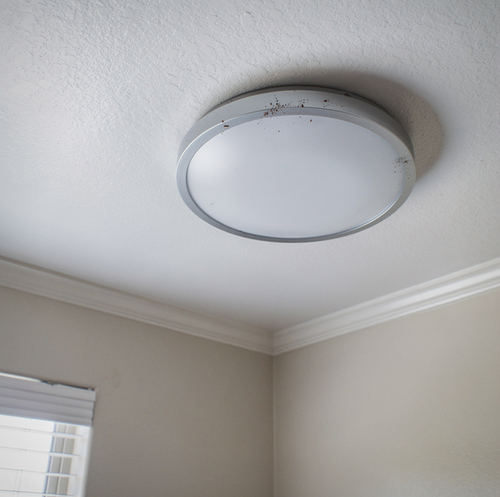
The wall switch goes down at bedtime, the room goes dark, and long after your eyes adjust, the ceiling fixture is still there: a dim glow from the LED bulbs, faint but steady. The old incandescent bulbs in that same fixture went fully black every night. Some current is plainly still reaching the bulbs.
That current needs a path. Several wiring paths can carry it, and one of them is a safety defect rather than a nuisance; the clues that separate them sit in the switch, in the timing, and in the wiring between the switch and the fixture.
Why an LED Lights on Current a Filament Ignores
An incandescent bulb produces light by heating a tungsten filament until it glows, which requires a real current. A 60-watt incandescent on a 120-volt circuit draws half an amp. Feed the same filament a few thousandths of an amp, and it warms by a trivial amount and stays dark, so any small leak past the switch disappears into it.
An LED bulb works on a different principle. Inside the base sits a driver, the power-supply circuit that converts line voltage into the low direct current the diode chips need, and the chips give off visible light at a few milliamps or less, a small fraction of the half amp that filament needed. A leak too small to warm a filament can collect in that driver and reach the chips as a faint, steady light. Fixtures with built-in LEDs behave the same way; their driver sits in the housing rather than in the bulb base.
One kind of glow needs no leak at all. The driver holds a little stored charge after the switch opens, and some lamps fade out over a short stretch as it drains. A glow that dies away on its own is that stored charge; a glow that holds all night has a current feeding it.
In a fixture whose switch and wiring had not changed, the leak had been there with the old bulbs too, passing unseen through their filaments; the LEDs only made it visible. A light that buzzes or flickers on a dimmer while switched on is a separate compatibility problem, and everything below concerns the fixture with the switch off.
Illuminated Switches and Electronic Dimmers That Never Fully Open
A standard toggle opens a physical gap in the hot conductor when you turn it off, and household voltage does not jump that gap. Some switches do not open a gap at all. A switch with a small locator light in the paddle powers that light by passing a small current through it and on through the fixture. In a switch with no neutral connection, the current's return path runs through the bulb. An incandescent filament passes it unnoticed. An LED driver collects it.
Electronic dimmers and timers can do the same thing by a different route. A dimmer that turns the light off with its own circuitry, rather than by opening a mechanical contact, can let a small current pass through its switching components while it is off. Some dimmers also carry a small network of components across the switching element to protect it, and that network passes a small amount of alternating current in the off position.
A dimmer or timer that breaks the circuit with a mechanical contact does not leak this way, and a locator-lit switch that powers its light from a neutral conductor keeps the lamp entirely out of the loop.
Smart Switches Installed Without a Neutral
A smart switch has a radio and a small processor inside that need power around the clock, including while the light is off. The clean supply is a neutral conductor in the switch box, which lets the switch draw its own power between hot and neutral without involving the fixture. Switch boxes in older homes can lack that neutral; a plain switch has no use for one, so a switch loop could be run with only the hot and the switched wire.
Smart switches built for boxes without a neutral get their operating power through the load instead: a small current leaves the switch, passes through the bulbs, and returns on the fixture's neutral. With LEDs on the circuit, the driver collects it, and the glow appears once the new switch goes in.
A smart switch with a neutral connected powers itself from that neutral, and this path closes.
Voltage Induced on Long Parallel Runs
Two insulated conductors running side by side act as a small capacitor along their length. When the switched wire to a fixture shares a cable or conduit with a wire that remains energized, alternating voltage on the live wire couples to the switched one, even with the switch open. Capacitance between two conductors increases with the distance they are apart, so a switch leg that runs a short distance beside a live conductor picks up very little, while one that shares a long run can pick up enough to light an LED.
An electrician's high-impedance meter reads this as ghost voltage: a reading on the open wire that collapses the moment a real load is connected. An incandescent filament is that real load, so the coupled voltage produced no visible symptom while the old bulbs were in. An LED driver draws so little at the start that the coupled current is enough to light the chips faintly, and the fixture glows on a plain mechanical switch with no light in it.
A Switch Wired in the Neutral Instead of the Hot
The last path is a wiring error, and it is dangerous. A switch belongs in the hot conductor, so that turning it off disconnects the fixture from the supply. If an installer put the switch in the neutral instead, turning it off still puts the light out, because the return path is open. The fixture, though, stays connected to the hot conductor. The socket, the driver, and every wire inside the canopy remain at line voltage with the switch off.
A fixture held live that way can find a small return path through the driver's internal components to the fixture's grounded metal, or through the capacitance of the disconnected neutral wire, and that small current faintly lights the LEDs. The glow is a minor symptom of a serious defect. Anyone who turns the switch off, trusts that the fixture is dead, and opens it to change a part is touching energized conductors.
A fixture switched in the neutral stays energized with the switch off, so its socket can shock anyone who opens it believing it is dead. Leave the fixture and switch alone and have a licensed electrician test which conductor the switch interrupts.
Telling the Paths Apart From What Else You Notice
The glow looks the same whichever path feeds it, so the sorting comes from the switch type, when the glow first appeared, and how far the wire travels to the light.
| Path | What else you notice | What separates it |
|---|---|---|
| Illuminated switch | A small light in the paddle or toggle stays lit while the fixture is off | Glow ends when a plain switch replaces it |
| Electronic dimmer or timer | The glow began when the dimmer or timer went in | A dimmer with a pull-out air-gap tab goes dark with the tab pulled |
| Smart switch, no neutral | The glow began with the smart switch; the box has no neutral | A neutral-powered model or the maker's bypass ends it |
| Induced voltage | Plain switch with no light; a long wire run to the fixture | Open-wire voltage vanishes under a test load |
| Switch in the neutral | Plain switch with no light; looks identical to induced voltage | The socket tests live with the switch off |
The two plain-switch rows carry the safety question. A glowing fixture on an ordinary toggle with no lights, no electronics, and nothing new on the wall is either coupled voltage, which is harmless, or a switched neutral, which is not, and nothing visible from the room separates the two.
Before the visit, write down what changed just before the glow appeared: new bulbs, a new dimmer or smart switch, a remodel, or any recent electrical work. That timing lets an electrician test the matching path first.
The Fixes an Electrician Chooses Between
Replace the switch: For a locator-lit switch or a leaky electronic dimmer, use a plain switch or a dimmer rated for LED loads that powers itself from a neutral to remove the leak at its source. A lit paddle stays an option with a replacement that powers its light from the neutral.
Bring a neutral to the box: Where a no-neutral smart switch is the source, a neutral in the box lets a neutral-type model power itself without passing current through the lamp. If a neutral already sits folded in the back of the box, this is a device swap; where none exists, a conductor has to be run to it.
Add a bypass at the fixture: A small bypass device wired across the fixture's input provides a path around the driver, keeping the driver from collecting enough to light. It suits induced-voltage and no-neutral smart switches, where rerunning the wire would mean opening finished walls.
Change the lamps: LED lamps differ in how much current their drivers require before the chips light, so a lamp from the control maker's tested list can stay dark while another lights on a leak. It is a quick fix and an uncertain one, since the leak itself remains.
Rewire the run: When induced voltage comes from a switch leg bundled with live conductors over a long distance, rerouting the switched conductor away from them removes the coupling. It can mean opening walls along the run, which suits a remodel.
Move the switch into the hot: For a switched neutral, this is the repair. A bypass or a different lamp would hide the glow and leave the fixture live when off, so neither one fixes this path. An electrician also checks the other switches and outlets on the circuit, because an installer who reversed one connection may have reversed others.
Frequently Asked Questions
At 120 volts, a leak of a few thousandths of an amp amounts to a fraction of a watt, and a no-neutral smart switch's standby draw is in a similar sub-watt range. The reason to deal with a glow is the chance that it is the switched-neutral defect, not the power it uses.
The leak is too weak to hold the chips on, so it charges a capacitor at the driver's input instead. When the stored charge reaches the level the driver needs to start, the chips flash, the capacitor drains, and the cycle begins again. A weaker leak takes longer to refill the capacitor, which is why the blink interval differs from one fixture to the next.
In a multi-lamp fixture, the sockets are wired in parallel, so every bulb shares the same leak. Even with one incandescent remaining, its filament gave the leak an easy path around the LED drivers and kept the voltage across them too low to light anything. With that last filament gone, the whole leak has nowhere to go but through the drivers.
No. A GFCI trips when it senses roughly 4 to 6 milliamps more current leaving on the hot than returning on the neutral. The leak behind a glow from a lit switch, a dimmer, or a no-neutral smart switch returns on the neutral like any other load current, so the device has no imbalance to act on, and the current that induced voltage pushes through a driver sits well under that trip level. A GFCI also does nothing to correct a switch placed in the neutral.
For a lit switch, a dimmer, a smart switch, or a switched neutral, yes: each starts at that circuit's hot. Induced voltage can come from another circuit's conductor sharing the run, so it can survive this breaker, and so can a glow fed through a mislabeled breaker or a shared conductor. A fixture still glowing with its breaker off needs an electrician before anyone touches it.
Yes, and the layout sets it up. A pair of switches controlling one light is joined by two traveler conductors that run side by side the full distance between the switch boxes. With the light off, one traveler stays energized while the other connects to the fixture, so the idle one picks up the coupled voltage along the entire shared length.
Find out which path lights your switched-off LEDs — a licensed electrician tests the switch, the run and the fixture, and confirms the switch breaks the hot conductor before choosing a fix. Zimmerman Electric Company serves Redondo Beach, Torrance, and Manhattan Beach. Call (310) 378-1323.