
Why Does Outdoor Lighting Keep Failing? Read the Pattern
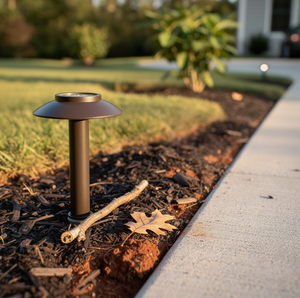
The path light by the driveway goes dark on a Tuesday. You check the bulb, swap it, and it works, until the next fixture down the walkway goes dark six weeks later, then the spotlight on the oak tree the month after that. Nothing about any single failure looks alarming. The pattern is the part worth reading.
Outdoor lighting fails in two distinct shapes, and each one points in a different direction. Fixtures going dark one at a time, spaced out over months, point to water working its way into the bodies of individual fixtures. A whole run going dark on the same night points at whatever feeds that run: a transformer, a timer, or a tripped GFCI. Dim far-end fixtures, lamps that die early, and connections that corrode all sit inside one of those two shapes once you know what to look for.
Fixtures That Fail One at a Time Point to Water
A single fixture going dark while its neighbors keep working rarely means the bulb burned out at random. Outdoor fixtures are built with a gasket at the lens and another where the stem meets the housing, and both sit between the weather and the electrical parts inside. Water rarely gets in through the lens gasket itself, which is the part most people check. It gets in lower down: up through the conduit fitting at the base, in at the whip connection where the fixture's own wire lead meets the housing, or through a stem seal that's been compressed and twisted one too many times during a planting or mulch job.
Once moisture reaches the bottom of the housing, it sits there, because a fixture built to keep water out is just as good at keeping water in. The socket sits at that low point in most designs, so the contacts corrode from below while the lens up top stays clear and dry-looking. Corrosion on a socket contact doesn't cut power cleanly. It adds resistance at the connection, and rising resistance first appears as flicker or a dimmer glow before the fixture stops working outright, so the warning arrives before the failure does, whether or not anyone is watching for it.
A Whole Run Going Dark at Once Points to the Supply
A different pattern: three fixtures, or all twelve, go dark the same night. Nothing about any individual fixture would explain that. What has changed is whatever feeds the whole line, and there are three usual places to look.
The transformer that steps household power down to the low voltage the run operates on can fail internally: a winding shorts, an internal fuse blows, and the output stops, taking every fixture on that run with it at once.
A transformer that trips repeatedly or runs hot has either a load past its rating or a fault on its power side. Total fixture wattage first; if within rating, leave the case closed, don't bypass the GFCI, and call an electrician.
A photocell or an astronomical timer that has drifted produces the same complaint for a different reason. That reads as a failure to anyone checking after dark at the usual time and finding it off, even though the system itself is now running on the wrong schedule.
The transformer plugs into an outdoor receptacle, and that receptacle is almost always on a GFCI. A GFCI that trips cuts power to everything downstream of it, including the transformer, and an exterior outlet tucked behind a planter or under a deck is exactly the kind nobody checks first. Press the reset button before assuming the transformer itself has failed: it is the cheapest thing to eliminate and the easiest to miss.
Low-Voltage Runs Fail at the Far End First
Systems built on 12-volt or 15-volt low-voltage wiring lose voltage as it travels, and that loss is proportional to both the distance the current travels and the current the fixtures on the line draw. The fixture closest to the transformer sees close to the full output. The fixture at the end of a long run, after the same current has pushed through a hundred feet or more of copper, sees less.
That drop shows up as a clear pattern: fixtures near the transformer run bright and last normally, while fixtures at the far end of the same run look dim from the day they're installed and burn out well before their rated life. It's easy to blame the fixture, replace it, and watch the replacement fail on the same schedule, because the fixture was never the problem. That's the first thing to check when one end of a run keeps failing, since wire length explains a repeat far-end failure more simply than several unrelated bad fixtures in a row.
Voltage drop grows with both the length of the run and the total wattage on it, so a reading at the transformer says nothing about the far end. Measure at the last fixture with every fixture on.
Splitting a long run into two shorter runs off separate transformer taps, or moving up to a heavier-gauge cable, brings the far end back up to the near end's voltage, and the fix lives entirely in the wiring, ahead of another round of lamp replacements.
A transformer loaded past its rated wattage compounds the same problem. Pushed past its capacity, it can't deliver its full rated voltage to any fixture on the run, so even fixtures near the transformer read slightly low. Removing a few fixtures to a second transformer, or moving up to a larger unit, restores the same voltage headroom a wire upgrade provides.
Heat Trapped Inside a Sealed Fixture Kills the Driver
An LED lamp is two parts: the diode that makes light, and a driver behind it that holds the current steady, sealed in the same housing that has to keep the weather out. The diode typically survives; heat kills the driver.
A sealed outdoor fixture holds still air around the driver, and the seal that keeps water out keeps that heat in. A driver running inside one, especially in a fixture that sits in direct sun much of the day, runs far hotter than the same driver would in open air. The small electrolytic capacitors inside the driver are the component most sensitive to that heat. Their electrolyte dries out faster at higher operating temperatures, which is why a driver's rated life drops sharply as its operating temperature climbs, even though the diode itself would have tolerated the same heat with no trouble.
Spray, Ground Movement, and Bad Connections Add Up
Three things in the ground and the air work against an outdoor system. Irrigation spray hitting a fixture on every watering cycle keeps a lens and gasket wet on a schedule the fixture's rain rating was never tested against. Most outdoor ratings assume rain and splash, not a jet of water striking the same spot several times a week.
Buried cable moves with the surrounding ground. Soil settles, mulch gets turned over, roots grow through a bed, and a run that was slack when it was installed ends up pulled tight at a staple or a splice. Enough tension eventually breaks a strand inside the jacket or works a splice open, and either one reads as a fixture failure at whatever sits downstream of it.
Every splice in a low-voltage run is also a place corrosion can start, and the connector matters. An indoor-rated twist-on wire connector, the kind sold for a junction box inside a wall, has no gel or gasket to keep standing water out. Water works into the twist over a season or two and corrodes the copper inside it, and that corrosion adds resistance at the splice the same way it does at a fixture socket: dimming, then killing, everything downstream of that one connection.
One check is worth repeating before anything gets replaced. A photocell or an astronomic timer running on the wrong schedule looks identical to a dead system when you only look once, so check it twice, at different times of day.
An electrician handles the transformer's power side and any line-voltage wiring feeding it. On the low-voltage side, a multimeter and a screwdriver reach the rest: read voltage at the last fixture on each run, open one questionable splice, and check a suspect fixture for water sitting in the bottom of the housing.
Frequently Asked Questions
Yes. Rubber and silicone gaskets harden and shrink with years of sun and heat exposure, and a gasket that has lost even a fraction of its original compression stops sealing long before it visibly cracks or looks damaged. A fixture can pass a glance and still be letting water past the seal.
Checking the output terminals with a multimeter is safe to do yourself and on the low-voltage side. Most transformers also have several voltage taps, often 12, 13, 14, and 15 volts, and a higher tap puts more voltage into the run at the source. Moving to a higher tap is a legitimate fix when an entire run reads dim, near end included.
They're getting wet more often than the fixture's rating assumes. Built for rain and splash, a fixture's seal treats repeated direct spray from a nearby head as a different kind of exposure entirely. Aiming the head away from the fixture, or moving the fixture out of the spray pattern by a foot or two, removes the stress without touching the wiring.
Often, yes. A driver nearing failure can show a warm color shift, a drop in output well before the light goes fully dark, or flicker concentrated at one point in its operating range, a different pattern from the flicker-then-failure that comes from a corroding socket connection.
Cable rated for direct burial carries a thicker, UV- and moisture-resistant jacket than typical lamp cord, and running it a few inches underground protects it from mower blades, foot traffic, and the wet-dry cycling that stresses a jacket left exposed on the surface.
Only if they're the two farthest from the transformer along the wire. Voltage drop depends on the wire's actual path length, and a run that loops or backtracks can place the electrically farthest fixture in a different spot than its physical position on the ground would suggest. Dim fixtures scattered with no relation to the wire distance are more likely to indicate a connection problem at that fixture.
Outdoor lights still going out? — Have a licensed South Bay electrician trace the run and find the actual fault. Zimmerman Electric Company serves Redondo Beach, Torrance, and Manhattan Beach. Call (310) 378-1323.