
Lights Brightening and Dimming on Their Own? What It Means
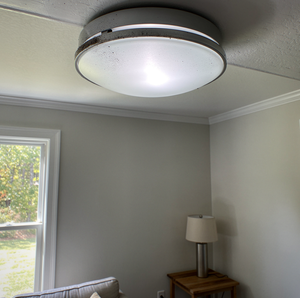
You are reading in the living room when the page brightens, then dims, then brightens again. Nobody touched a switch. A minute later it happens once more, and now the lamp has your attention. Lights that change level on their own cover an enormous range, from a motor doing exactly what motors do to a fault that can ruin every piece of electronics in the house inside a week. The way the lights behave does most of the sorting.
The Difference Between a Sag and a Swing
Two households can describe this in the same words and be looking at completely different faults. A sag is a brief drop that recovers: something demanded a lot of current at once, the voltage at the lamp dipped for a fraction of a second, and the light returned to where it had been the moment the demand settled. It moved one direction, down and then back.
A swing is easy to overlook until you go looking for it. Lights go up and down without anyone in the household asking for anything, and one part of the home goes bright at the same instant another goes dim. Down-and-back is the ordinary end of this symptom. Opposite movement in two places at once is the end that carries real danger.
Lights that brighten in one part of the home at the same moment they dim in another point to a failing neutral connection, most often in the service. That is a fire and shock risk. Call a licensed electrician now.
Momentary Dimming When a Big Motor Starts
The compressor in an air conditioner draws several times its running current the instant it starts. A motor sitting still has no rotation to oppose the incoming current, so the first fraction of a second at start-up draws a large inrush before the motor spins up and settles into its normal draw. That inrush travels through the same service and wiring that feed your lights, and the voltage reaching the lamp drops slightly during the inrush.
Well pumps do it. Garage door openers do it. Refrigerator compressors and central air units do it every time they cycle. The signature is recovery: within a second, the lights return to their previous level and stay there, and nothing in the house gets brighter.
When the Sag Stops Being Routine
The same event still tells you something if it changes over time. A dip that used to be barely noticeable and now darkens the room, or one that used to snap back instantly and now hangs for a beat, means something in the path between the utility and that lamp has shifted. Connections loosen, conductors corrode, and loads grow as a household adds equipment. When you call, describe how it has changed as well as what it does.
Brightening in One Room While Another Dims
Lights that brighten on their own are not responding to the bulb or the fixture. They are reporting on the supply feeding the whole house. A typical home is fed by two energized legs plus a neutral. The 120-volt circuits inside are split between those legs, roughly half on each, and the neutral is the shared return path both halves rely on. Its second job matters more when it fails: the neutral holds the two halves at a fixed level, so heavy load on one side does not affect what the other receives.
A plank across a fulcrum stays level only while a locking pin holds it there. Pull the pin and the plank is free to tilt: whichever end carries the weight drops, and the far end rises. A service neutral that has corroded, loosened, or broken does that to a house. The two halves are no longer held apart, and they divide the incoming supply between them according to the load each is carrying. Switch on something heavy on one side, and the voltage there falls while the voltage on the other side climbs. Lights on the lightly loaded half brighten at the same instant lights on the heavily loaded half go dim, and the picture shifts again every time a large appliance cycles.
The Damage It Does to Electronics
Anything built for a nominal 120 volts and handed more than that runs hot. Power supplies in televisions, computers, routers, LED drivers, and appliance control boards give out first, sometimes during the event and sometimes weeks afterward. Resistive heating elements tolerate excursions much better. Motors on the low-voltage half face the opposite problem, drawing extra current and running hot while voltage sags. A household can lose several devices this way in a month and never connect them to the lights.
Why It Is a Fire and Shock Risk
A failing neutral connection is generally a loose or corroded joint still carrying current, and a joint in that condition heats and arcs at the point of failure. The neutral is also the conductor that ties the electrical system to the grounding system, so when it degrades, return current looks for another path back and can travel through metal water piping, appliance cases, and other bonded metal meant to sit at zero. Metal you have touched safely for years may not be safe.
Whose Side of the Meter It Sits On
The failure can be on the utility's run to the building, at the splices where the service conductors land, or at the pole. It can just as easily be on the customer's side: the neutral lug in the meter socket, the service-entrance conductors, or the main neutral connection inside the panel. From a living room, the two look identical. A licensed electrician determines which party is at fault and coordinates with the utility when the fault lies with them. This is not a condition to live with while you decide, because the pattern does not settle on its own. It repeats every time the load shifts, and each repetition is another overvoltage event on whatever is plugged in.
Flicker That Stays on One Circuit
One room, one fixture, one branch of the wiring: a flicker with a small footprint usually has a short list of causes behind it. A receptacle whose wires were pushed into the back rather than clamped under the screws, a connector that never got fully tight, a switch terminal loosened by years of heating and cooling, or a breaker connection at the panel serving that circuit. The lights on it stutter, nothing else in the house responds, and nothing anywhere gets brighter.
A small footprint can still carry a large consequence. A loose joint heats every time current passes through it, and that heat can char insulation and ignite nearby material inside a wall. A single-circuit flicker is still a call to an electrician.
A burning or fishy smell, a warm cover plate, or buzzing at the panel changes the timeline. Shut that circuit off at the breaker, leave the panel cover closed, and call for service immediately rather than watching it.
When the Whole Street Is Affected
Ask the neighbors. If the house next door sees the same dips at the same moments, the fault sits upstream of every meter on the block and belongs to the utility. Large loads switching on a shared distribution line, a failing connection at the utility's pole-mounted equipment, or crews working on the line can all produce voltage variations that affect several homes at once.
The tell is easy to read: symptoms shared across separate services point outward, toward equipment nobody in the house owns, while symptoms stopping at your property line point inward. A utility-side problem gets reported to the utility, which dispatches to its own equipment, a different call from the one you place to an electrician.
Dimmers, Drivers, and Mixed Loads
Dimmers produce trouble that looks far worse than it is. An LED lamp contains a driver, a small power supply that converts the incoming voltage into the steady current the diodes need. Older dimmers chop the waveform for incandescent filaments, which absorb whatever they are given. Feed a chopped waveform to a driver expecting something smoother and the light stutters, shimmers, drops out at the bottom of the slider's travel, or glows faintly when off.
Mixing loads does the same thing. Two brands of LED, or an LED sharing a dimmer with an old halogen, hand the control something it was never built to handle. The pattern gives this one away: it shows up only on dimmed fixtures, often only across part of the slider's range, and nothing else in the home reacts.
Sorting Your Own Symptom Without Opening Anything
Four questions get most households close to an answer before anyone picks up a tool.
- Where does it show up? One fixture or one room points at that fixture or that circuit. Lights throughout the home point to the service, the panel, or the utility.
- Does it track anything? Watch for a link between the change and an appliance starting or cycling. A tight correlation with a big motor points one way; changes with nothing running point another.
- Does anything get brighter? This one matters most. If a fixture in one part of the home rises while a fixture elsewhere falls at the same moment, stop working through the list and make the call.
- Do the neighbors see it? Shared symptoms across separate homes move the problem to the utility's side of the meter.
Everything past those four questions needs test equipment and training on energized parts. Nothing on this list asks you to open a panel, pull a device, or put a meter on anything, and none of that belongs in a homeowner's hands.
Frequently Asked Questions
Yes. A television, microwave, phone charger, or anything with a standby supply stays connected the whole time it is plugged in, and it sees whatever voltage reaches the outlet even with its own switch off. Unplugging is what removes a device from the fault.
An LED lamp runs on a driver that regulates output across a range of input voltages, so it maintains a fairly steady brightness while an incandescent or halogen fixture on the same side of the house climbs and falls visibly. The regulation hides the symptom without sparing the driver: one that spends time above its rated input often fails weeks or months after the wiring is repaired.
Yes, on a smaller scale. Some homes are wired with shared-neutral circuit pairs, where two energized conductors from opposite legs share a single neutral return, often feeding a kitchen or a run of bedrooms. If that neutral loses its connection, the pair tilts the way the whole service does, but only across the rooms it feeds. Everything else looks normal, which makes it easy to blame the fixtures.
Not necessarily. The service drop, the run of conductors between the pole and your own connection point, along with its splices and terminations, serves your home alone. A neutral fault in that stretch is on the utility's side and still produces a symptom nobody else on the block can see. Neighbors reporting the same behavior confirms a shared upstream problem; their silence leaves both sides open.
It can be the appliance instead of the house. A motor with a worn start capacitor or dragging bearings takes longer to reach speed, which stretches the inrush and deepens the dip every cycle. An electrician looking at a worsening sag checks the circuit and connections feeding the unit, and if those test sound, the motor and its capacitor are a job for the equipment's service technician.
The repair occurs at the connection, but equipment that experienced overvoltage can fail afterward on its own schedule. Two items get overlooked in the sweep through the obvious electronics: hardwired smoke and carbon monoxide alarms, which are electronic devices with a service life, and any AFCI or GFCI breakers and receptacles, whose sensing circuitry is solid-state too. Ask for both at the same visit.
Book a service and neutral check — have a licensed electrician find out why one room brightens while another dims before anything else gets damaged. Zimmerman Electric Company serves Redondo Beach, Torrance, and Manhattan Beach. Call (310) 378-1323.