
Why Your TV Speakers Hum When the Cable Is Plugged In
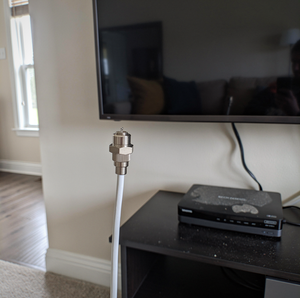
You notice it in the pause before a scene starts. Under everything your speakers do sits a low drone that nobody stops hearing once they notice it. It does not rise when you turn the volume up. It does not go quiet when you change inputs. You heard it through both movies you sat down for last night.
Then someone unscrews the coaxial cable from the back of the set, and the room goes silent. Screw it back on and the drone returns. That observation moves your trouble out of the speaker cabinet and into your house, and it narrows your answer faster than anything you will find in a forum, which is worth knowing before you buy a thing.
The Hum Arrives With the Coax and Leaves With It
The tone is steady. It does not follow the picture, it does not pause between scenes, and it sits there as plainly on a news channel as on a film. Nothing about it sounds like a speaker giving out, and nothing about it sounds like an amplifier working too hard. It is a sound with no musical reason to exist, laid flat underneath everything else in the room.
And it belongs to one cable. Unscrew the coaxial connector at the back of the set or the cable box, and the hum goes away. Thread it back on, and the hum comes back. You can run that loop as many times as you like.
What Whines Through the Speakers, and Where Does It Start?
Ground loop problems are caused by small voltage differences that normally exist between the grounds at the send and receive ends of a signal cable. In an unbalanced interface, such as video and consumer audio, that ground voltage difference adds directly to the signal, which generally produces hum or buzz in audio and hum bars in video. Every clause of that describes the room you are sitting in tonight.
In plain terms: the metal shield of the cable coming into your house and the round pin on your television's power plug both end at earth, but they get there by two different roads. Those two arrival points are not at the same voltage. They sit a small voltage apart, which is nothing to a person and quite a lot to an audio circuit expecting a stable zero to measure against.
A consumer television connection is unbalanced, which means the shield that provides the ground also carries the reference the signal is read against. There is no second wire to cancel the error out. So the difference between those two earths rides into the amplifier as though somebody had recorded it, and the speakers do what speakers do.
Two Ground Paths Meet at the Back of Your Television
Follow the cable backward from the set. It runs to a splitter, out through the wall, and down to a small grounding block where the street drop lands. A bonding wire leaves that block and runs to your home's electrical service, and along it the coaxial shield reaches earth. Now follow the power cord forwards. It goes to a receptacle, whose equipment ground runs back through the walls to the same service by a different route. The two roads leave the same place and arrive at your television separately.
Two conductors joining at the same point form a loop, and a loop with a small voltage across it will carry a current. That current crosses the signal connection at the back of your set, so it lands where the audio is referenced. Add a cable box on one receptacle, a receiver on another, and a soundbar on a third, and you have not made one loop but several, each with its own path and its own small difference. This is why hum often gets worse as a system grows.
Plenty of people will tell you to break the loop by taking one of its two ends off, and the ground pin on the television's plug is the easier end to reach. That works, in the sense that the noise stops. It also removes the path a fault current is supposed to take. The safety rule is stated without qualification: never remove the ground pin, the third prong, to make a three-prong plug fit a two-prong outlet.
Cutting the ground pin off a television, receiver, or soundbar cord, or using a three-to-two cheater adapter, can leave the metal case live during a fault and shock anyone who touches it, so have a licensed electrician fit a CATV ground isolator instead.
What Whines on Cable but Goes Quiet on an Antenna?
An indoor antenna changes the picture entirely, because nothing conductive runs from it back to the utility. A streaming stick changes it even more, since the only things entering the set are a radio signal and a short lead. Households that hum on cable and sit silent on either of those have already told you where the second ground path enters the building.
Swapping speakers proves nothing, and neither does a new cable between the box and the set, because both sit inside the room rather than at its edge. The loop you are chasing starts outside, at the point where a line owned by somebody else comes through your wall.
Telling a Ground Loop From the Noises That Imitate It
Not every unwanted sound near a television has this cause, and the difference shows up in what makes it change. A loop through the cable drop tracks one connector. A noise born inside a component tracks that component's power switch. Interference riding a nearby circuit tracks a dimmer or a lamp instead.
| What you hear | What changes it | What it points to |
|---|---|---|
| A steady low hum or buzz behind every input | Unscrewing the coaxial connector silences it | A loop through the cable drop |
| The same hum with the coax already off | Powering down one box in the rack | A supply or a fault inside that box |
| A harder buzz that comes and goes | A dimmer, a lamp, or an appliance nearby | Interference on a nearby circuit |
The middle row matters because most people skip it. If the hum persists with the coaxial cable disconnected from the back of the set, the cable drop is not your problem, and no isolator on earth will help you.
The Isolator That Breaks the Loop, and What It Cannot Do
The remedy is as plain as the cause: a ground isolator in the signal path is the correct way to eliminate a system ground loop problem. A transformer does this by magnetically coupling the signal across an electrically insulated barrier. For an unbalanced interface, it effectively prevents current flow in the cable caused by ground-voltage differences, thereby suppressing the noise. The signal crosses; the current does not. The loop is open, and the tone is gone.
For a cable television drop, the part goes in series with the line, between the wall and the equipment rather than inside the set, and it works just as well to get rid of audio hum and buzz with standard cable TV. Fitting one is quick work for somebody who already has the rest of the picture in front of them.
It is not a universal part. This kind of isolator is ruled out for RG11 cable and for satellite systems, so the question of which drop you actually have gets answered before anything is ordered. An isolator chosen without that check is a part that arrives and then sits in a drawer.
The Bond at the Coax Ground Block Is Not Yours to Move
The other end of the loop sits outside, on the wall where the cable enters. A small metal block holds the drop, and a wire runs from it to the electrical service. Forum advice about hum reaches that wire eventually, usually phrased as a quick snip. Cutting or unscrewing it does break the loop. It also removes the path a surge or fault on that line is meant to follow.
With that path gone, the cable's shield can sit at a potential it was never meant to reach, and it carries that potential indoors along the same cable that ends at your television. Whoever is handling the connector at the time is in the way. The bonding wire at that block belongs to a licensed electrician or the cable provider's own technician.
Whether the bond at your house is right, and what has to change if it is not, is a determination for that electrician or technician to make on-site. It is not something to settle from a forum thread, and it is not something to read off a diagram of somebody else's house.
What to Have Ready Before Anyone Comes Out
Write down what changed and when. The month the hum started, whatever arrived in the rack that month, and which receptacles everything is plugged into are worth five minutes of your time, because they shorten the visit. Note whether the drop is the original or a replacement, and whether the hum came in a new box from the cable company rather than something you bought yourself.
Ask for both halves of the work in one scope. An electrical repair visit here covers grounding among other things: breaker panels, home appliances, frayed wires, and basic home safety, checked with repairs, upgrades, or rewiring recommended as needed. The television side sits with the same trade here.
Before any of that, though, run the test that separates the two possibilities. Unscrew the coax and listen. Silence points outside your house, to the drop and its ground path. A hum that stays points inside, to a box on your shelf.
Frequently Asked Questions
No, and the swap is wasted effort. The noise is not riding on the picture cable between your box and your set; it is riding on the shield of the line coming into your house from outside. A gold connector changes nothing at all about the difference in voltage between two grounds. Keep your attention on your drop and on who inspects it.
Because you moved one end of the loop. A different receptacle means a different run of wire back to the service, a slightly different voltage at that point, and a different amount of current through the shield. It is a real clue and a poor cure, since the hum usually comes back the next time your equipment moves or your neighbor's does. Treat it as information about your own house.
You can, and plenty of people do. What you lose is the cable service you pay for, and what you keep is a ground path still bonded at the block outside whether the connector is on your set or not. If the hum is the only reason you would give up the drop, it is worth having someone look first, because the same loop can find another way into the room later on.
Probably not. A soundbar rarely creates the difference in voltage; it gives an existing one a new road to travel. Before you added it, the loop in your house may have had nowhere useful to go. A second grounded box on a second receptacle completed a circuit that was waiting. Returning your soundbar puts you back into a quiet system, which is not the same as a system somebody has repaired for you.
The sound itself is not tearing anything apart, and your system can hum for years without a part failing. The reason not to live with it sits elsewhere. A current flowing along your cable shield is current going somewhere nobody designed it to go, and the arrangements people improvise to silence it are the damage. Cut ground pins and removed bonds turn your annoyance into something that can hurt whoever touches it. Treat the hum as a message about your house and your wiring, and you will treat it correctly.
Both, in the right order, and the order depends on what your test shows. If the hum stops the moment the coaxial connector comes off, the loop runs through the drop, and two things may be true at once: the drop may need an isolator in series, and the way it is bonded at the block outside may need attention. The provider owns the line up to your house and will look at the drop and the block. A licensed electrician owns everything on the other side of that wall, and the grounding of the service that block is bonded to belongs to that trade. Ask each of them what they found at your place, and get their answer in writing before work starts.
Hearing a hum that stops the moment the coax comes off — Have a licensed South Bay electrician trace the loop, fit a CATV ground isolator in the drop, and check how the cable is bonded at the service before you go buying new speakers. Zimmerman Electric Company serves Redondo Beach, Torrance, and Manhattan Beach. Call (310) 378-1323.