
Recessed Outlet Behind a Wall-Mounted TV: What It Solves
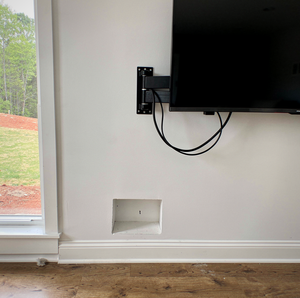
A television bracket can pull a panel to within an inch of the drywall, and the plug behind it gives that inch back. The cord leaves the set, meets the receptacle, and turns. That turn needs room, and the room it takes sits between the back of the screen and the wall it should sit flat against.
A recessed outlet moves the hardware behind the wall surface so your plug never protrudes past it. Whether you need one depends on how close you want your screen to sit, on what you are running behind it, and on who is doing the work. You can answer all three before anyone cuts into your wall, and that is the easiest moment you will ever get.
The Plug Behind the Screen
Mounting hardware is thin. A low-profile bracket holds a panel less than an inch off a finished wall, and tilting versions add little more. A receptacle is thin too, since the yoke sits flush and the plate adds a fraction of an inch. The parts that stop being thin arrive after the plug goes in. A molded plug body stands off the wall on its own, the cord leaves it either straight out or at a right angle, and a cord bent hard against a panel pushes back. Add a signal cable behind that screen, and the stack behind your television is deeper than the bracket ever was.
A recessed box made for this exact geometry sits inside the wall cavity with its opening flush to the drywall surface, and the receptacle, the plug, and the first bend of the cord all live down inside that opening. Nothing about the receptacle itself changes. The plug simply ends up on the far side of the wall surface.
None of this comes up on a stand. A television on a credenza has a foot of air behind it and a cord that is free to loop where it likes. On a wall, that same cord has nowhere to go, so a geometry nobody thinks about in a showroom turns into the whole question in your living room, months later.
The point of a recessed TV box comes down to one line: plugs and connectors stay inside the box without extending past the wall, so nothing behind your screen ever stands proud of the drywall surface.
A Recessed Box Is a Listed Product, Not a Hole in the Drywall
These are manufactured enclosures that a testing laboratory has evaluated and lists for safety. Recessed television boxes come in non-metallic or steel, with a paintable white non-metallic trim plate, in two-, three-, and four-gang styles. The steel version suits new or old commercial work where a metal raceway is used. Each of those attributes is a claim you can hold against the box on the shelf, because someone printed it on the specification sheet and marked the carton it ships in.
An opening cut in drywall with a receptacle floating loosely in it has none of that behind it. There is no enclosure around the connection, nothing fastened to the framing to carry the weight of a plug being pulled out, and nothing square for a trim plate to land on. The improvised version also gets no second look, because the wall closes over it the same afternoon and the only person who ever saw the inside was the one holding the drywall saw. That matters most to whoever owns the house next.
The Television Cord Was Never Made to Live Inside a Wall
The mechanism here is heat. A flexible cord radiates warmth into the surrounding air, and a wall cavity is not open air. Safety guidance on extension cords puts the physics plainly: a cord should not run through walls, doorways, ceilings, or floors because if it is covered, heat cannot escape, creating a fire hazard. A television's molded cord is a different product from an extension cord, and it has the same need as any flexible cord to send its heat somewhere.
Mechanical damage runs on a longer timeline. A cord dropped down a stud bay can chafe on a framing edge as the wall moves, sit where a plate crushes it, or take a screw driven blind from the next room by somebody hanging a shelf. None of that shows up as a symptom you can see. The harm lands as a fire in a closed cavity above the sofa where you watch television, or as a shock to whoever next opens that wall later on.
A television's molded cord cannot shed heat inside a closed stud bay, and a pinch or a driven screw there can start a fire above your sofa, so have a licensed electrician run a branch circuit to a recessed box.
New Construction and Retrofit Hold the Box Two Different Ways
The fixing changes between an open wall and a finished one. In new construction, the box screw mounts to a wood or metal stud. In retrofit, mounting wing screws hold the box securely in the wall. Open framing allows the box screw to be driven into a stud before drywall goes up. In a finished wall, the wings swing out behind the board and clamp the box against it.
Adding it later is still not free. The box has to land in a bay clear of framing, blocking, and whatever plumbing or ducting shares that wall, and it has to sit where the bracket's wall plate and lag bolts will not cover it. A finished wall also hides where the nearest circuit runs, so the route to this spot gets worked out from a panel directory rather than from plain sight.
Line Voltage on One Side and Class 2 Cable on the Other
The combination version of the box carries power on one side and low voltage on the other, with that low-voltage side taking Class 2 wiring for satellite, cable television, speakers, and more. Two compartments in one opening, with a divider between them, let a single cut in the drywall serve both the receptacle and the signal run that ends up behind your screen.
That separation is not decorative. Line-voltage conductors and Class 2 cable are meant to be kept apart, and a single undivided box puts them in contact. The divider also earns its keep the day a soundbar, a streaming stick, and an antenna all want the same square foot of wall instead of a bay each and a second cut.
The Order of Operations Around a Wall Mount
The sequence runs backward from the picture in your head. Screen height comes first, then the bracket holding it, then the stud it lands on, and only then the spot where a box can go without fighting any of that. The electrician runs the circuit and installs the box while the bracket is still in its box.
Wait until the screen is up and those steps come undone in reverse. The panel comes off the arms, the arms come off the wall, and a patch and paint job appears beside the mount that nobody scheduled and nobody budgeted, on a wall that was painted and finished a week ago.
Frequently Asked Questions
Yes, the retrofit fixing makes it possible. That installation is rated for walls up to a half-inch thick, ordinary drywall included. Plan your location against your bracket's footprint rather than the screen outline, since the arms and lag bolts occupy the space where you would put it.
No, and centering it is usually wrong. The middle of your screen is where the bracket plate and its fasteners already sit. Offsetting the box to one side of the panel keeps the opening reachable and leaves your plug clear of the arms the day you have to swap a cable.
Usually a cabinet below, with a signal path up the wall to your screen. The cable making that run differs from the patch cord in the box your equipment came in by the jacket rating printed along it. Buy it once and label both ends before you close up the wall.
It works against you. A strip adds its own body, its own cord, and its own bend behind the panel, which is the depth you were trying to remove, and it leaves a cord run where it can be pinched. Surge protection belongs at a receptacle built for it, not stacked in the gap behind your screen.
Less than you expect. A recessed box takes an opening sized to its gang count, and the trim plate covers the cut edge. Covers are also made for unused two-gang through four-gang boxes, so an opening larger than your needs can be closed off and reopened when your equipment changes. The patching that follows is around the plate, not the wall.
Both parts land on the same wall within an hour, so one crew removes the handoff, with each side assuming the other did your cable. A television installation here includes securely mounting the TV on a bracket or platform and managing the wiring and cabling to prevent tripping. Check that both appear in your own written scope before you sign, because they are split between two trades more often than not.
Thinking about a recessed outlet before the screen goes on the wall — Have a licensed South Bay electrician look at the bay, the bracket line, and the circuit while the drywall is still closed and nothing behind it has been cut yet. Zimmerman Electric Company serves Redondo Beach, Torrance, and Manhattan Beach. Call (310) 378-1323.