
Outlet Sparks When You Plug Something In: Normal or a Warning?
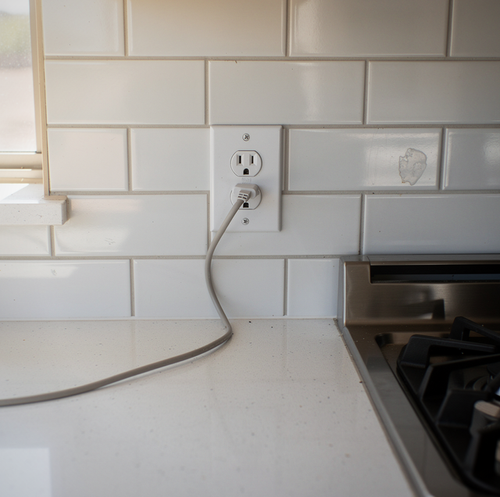
Quick Answer: A plug makes its connection in stages. If the device at the end of the cord is switched on, its blades carry current as soon as they meet the metal contacts inside the slots, and for the last sliver of travel, the two are close without making firm contact. Current jumps that small air gap as an arc, the flash visible at the face of the outlet. Once the blades seat and the contacts clamp down, current has a solid metal path, and the flash is gone. That is why a brief, small spark can happen at a healthy receptacle, and why a spark that is bigger, louder, or repeated deserves a closer look: something is holding the gap open, or the path behind the slots is worse than it should be.
Reading a Spark by Its Size, Sound and What Follows
Each sign a sparking outlet can give is matched with what it signals when it stays brief and small, and when it repeats, grows or gets loud:
| What you see or hear | Brief and small | Repeated, large or loud |
|---|---|---|
| A tiny blue flash as a switched-on device goes in | The device drew current just before the blades seated | The contacts or the plug are holding the gap open |
| A spark with a crackle or a pop | One faint tick as a heavy load connects | Arcing strong enough to hear, heating the slot |
| A spark every time at one receptacle | Only one switched-on appliance does it | Worn contacts or a loose connection there |
| Sparks with a plug that falls out or feels loose | A loose fit alone already signals weak contacts | The gap reopens each time the plug shifts |
| Sparks followed by a tripped breaker | No harmless reading | A circuit fault; the receptacle stays out of use |
| Sparks with a smell, discoloring, or heat at the plate | No harmless reading | Heat at a connection; the receptacle stays out of use |
A single flash when a space heater left on gets plugged in comes from the load. A flash at one receptacle, no matter what goes into it, comes from that receptacle's contacts or its connections. Heat and scorching at the plate are never part of a normal spark, and that receptacle is no longer in use until an electrician has opened and checked it.
Which receptacle sparked, what was plugged in, whether that device was switched on, and whether a sound came with it give the electrician a starting point, since a spark may not repeat while someone is watching.
Why Switching a Device Off First Changes the Spark
A device with a plain mechanical switch that is turned off draws no current when its plug is inserted. The blades seat with nothing flowing through them, so there is nothing to jump the gap. When you flip the device on, the moment of connection moves inside the appliance to a switch with enclosed contacts designed to open and close under load.
The size of a plug-in spark follows the size of the load. Anything that makes heat with a resistive element, such as a space heater, a hair dryer, a toaster or an iron, draws its full current from the first instant of contact. Motors in vacuums, fans, and window units draw a start-up burst larger than the current they draw once running. When plugged in with the switch on, they produce brighter flashes, even at a receptacle in good condition. Electronics that answer a remote or show a clock or standby light keep part of their circuitry awake when they look off, so they can show a faint flash on insertion even after the power button is pressed.
Switching off the heavy load first spares the contacts and also serves as a check. When a device with a plain mechanical switch is off, and a spark still appears, the cause sits outside the switch, in the cord, the plug, or a loose connection behind the receptacle, and that plug stays out of the wall until the cause is found.
Spring Contacts That No Longer Grip the Blades
Inside each slot sits a pair of spring-metal contacts that pinch the plug's blade from both sides. The tighter that pinch, the larger the area of metal touching metal and the smaller the resistance at that point.
That pinch weakens. Every insertion flexes the contacts open, heavy plug-in chargers and adapters hang their weight off the blades, and cords yanked out at an angle lever the contacts wider than they were built to go. Heat adds to it: each arc warms the contact metal, and metal heated over and over loses some of its spring, so it stops snapping back to its original grip.
A contact that has lost its grip touches the blade over a smaller area, so resistance and heat at that spot rise during normal use, softening the spring further. From the room side, the signs are a plug that droops or drops out under its own weight, a lamp that flickers when its cord gets bumped, and a spark from ordinary plugs there.
The contacts are sealed inside the receptacle body, so a worn set is fixed by replacing the whole receptacle. Bending or spreading a plug's prongs to make it fit more tightly is the wrong fix: it forces the blades against contacts that are already weak, strains the plug, and bent prongs can damage the next receptacle they go into.
Loose Terminals and Wires Behind the Plate
Behind the cover plate, the circuit wires attach to screw terminals on the receptacle's sides, or, in some installations, to push-in holes on its back. On a circuit that runs from one receptacle to the next, those terminals carry power to every receptacle further down the line, so they also carry current for loads plugged in elsewhere.
A screw that was never fully tightened, a wire looped counterclockwise so that tightening the screw pushed it outward, and wire that expands and contracts under the screw with each load can all leave a connection that is snug one day and loose the next. A receptacle mounted loosely in its box adds movement: pushing a plug in shoves the whole device back, the wires flex, and a marginal connection opens and closes again.
That movement is how a loose terminal shows up as a spark when you plug it in. The push breaks and remakes the connection behind the plate, and the arc can be seen at the slots or heard as a crackle from inside the wall.
Arcing at a loose terminal occurs behind the cover plate, beside wire insulation, and inside the wall, where heat builds unseen and live contacts are within reach. Removing the plate and handling those connections are the responsibility of a licensed electrician.
A receptacle that crackles, pops, or sparks again and again is switched off at its breaker, when the panel can be reached safely, and left alone until an electrician opens it.
Damaged Plugs and Cords at the Device End
A sound receptacle can still spark when the fault arrives on the end of the cord. Blades that are bent, spread apart, or loose in the plug body make poor contact in any receptacle, and a cracked plug housing lets the blades shift as the plug goes in. Cords pulled out by the cable, pinched under furniture, or closed in a door can break some of the fine strands inside the conductor where the cord meets the plug, and a partly broken conductor can arc inside its own insulation.
When the same cord has sparked at more than one receptacle, the cord is the shared factor. When several different cords spark at one receptacle, the receptacle is. Those two observations separate a plug problem from a wiring problem without any testing at the outlet.
A plug or cord with that kind of damage stays unplugged until the cord is replaced or the appliance is serviced; taping over a cracked plug or a split jacket does not restore a safe connection. A damaged plug used in a receptacle for a while can leave the receptacle damaged, too.
When a Spark Comes with a Tripped Breaker
A spark followed by a tripped breaker means the breaker detected a condition on the circuit that warranted cutting power, and finding that condition is its own diagnosis. Whatever the cause, the receptacle stays out of use, the breaker stays off, and the device stays unplugged until the circuit has been checked.
Testing and Replacing a Receptacle That Sparks
The electrician starts with the circuit switched off and proven dead at the device before the cover plate comes off, then pulls the receptacle from its box to examine its terminals, the wire ends, and the insulation near them for looseness, discoloring, brittleness, or melted plastic, trimming heat-damaged wire ends back to sound metal where the length allows.
The electrician secures each conductor of the new receptacle under its screw terminal, tightens it, and fastens the device firmly to the box so a plug push no longer moves it. With power restored, the electrician checks the new receptacle for correct wiring and polarity, and the other receptacles on the same run as well, because a loose connection at one device in the chain can show up as trouble at the next. Where heat damage runs further along a wire than it can be trimmed, the repair extends to that run of wiring, and the circuit is tested under load once the work is done.
Frequently Asked Questions
A charger stores a charge in a capacitor on the input side of its small electronic power supply. When its blades meet the contacts, that capacitor charges from empty in a quick burst of current, and the burst can jump the last gap as a faint flash, even with no phone attached. A charger that also runs hot, buzzes, or smells has a fault inside its housing and should be replaced.
Each arc melts a microscopic amount of metal where it jumps, leaving tiny pits and a dark film on the blade tip and on the matching contact inside the slot. Light darkening at the tip is ordinary wear. Deep pits, melted edges, or discoloring that creeps up the blade toward the plug body signal heat, and both the plug and the receptacle it lived in are candidates for replacement.
No. Vacuums, blenders, and corded drills with brush-type motors feed current into the spinning part of the motor through carbon brushes, and a faint flicker of sparks at that sliding contact is part of how those motors run. The receptacle plays no part in it. A ring of heavy sparks or a burning smell from the housing signals worn brushes or a failing motor, which is appliance service.
A tamper-resistant receptacle, marked TR on its face, has spring-loaded shutters behind the slots that open only when both blades press on them simultaneously. A plug pushed in at an angle, or one blade ahead of the other, meets a closed shutter and stops. Pushing the plug straight in opens both shutters together, and stiff insertion at a TR receptacle is the shutter doing its job.
No. The spark forms on the two flat blades, which carry the current, and the round grounding pin carries none in normal use. On a three-prong plug, the grounding pin is the longest of the three, so it touches first and leaves last, clear of the arc. A missing or broken ground causes no spark and no visible indication at a three-slot receptacle, so it only shows up when the receptacle is tested with an instrument.
Yes. Water lying between the two blades or inside the slots provides a path for the current across the face of the plug. That leakage can crackle, arc, and leave a dark carbon line on the plastic between the slots, and the carbon line continues to conduct after the water dries. A receptacle with a dark track between its slots needs replacement, while one that only took a splash stays unused until it is completely dry.
Enlist outlet repair and testing for the receptacle that sparks — contact and terminal checks, receptacle replacement and a circuit test under load. Zimmerman Electric Company serves Redondo Beach, Torrance, and Manhattan Beach. Call (310) 378-1323.