
Do You Need a Panel Upgrade for an EV Charger?
QUICK ANSWER: It depends on your panel’s capacity and available space. A Level 2 EV charger draws significant power — often a 240-volt, 40-to-60-amp circuit — so the question is whether your panel has enough spare capacity and an open slot for that circuit. Homes with a modern 200-amp panel and light existing load often can add a charger without an upgrade; homes with an older 100-amp (or smaller) panel, or one that’s already near capacity, frequently need an upgrade. An electrician performs a load calculation to determine whether your specific panel can support a charger safely.
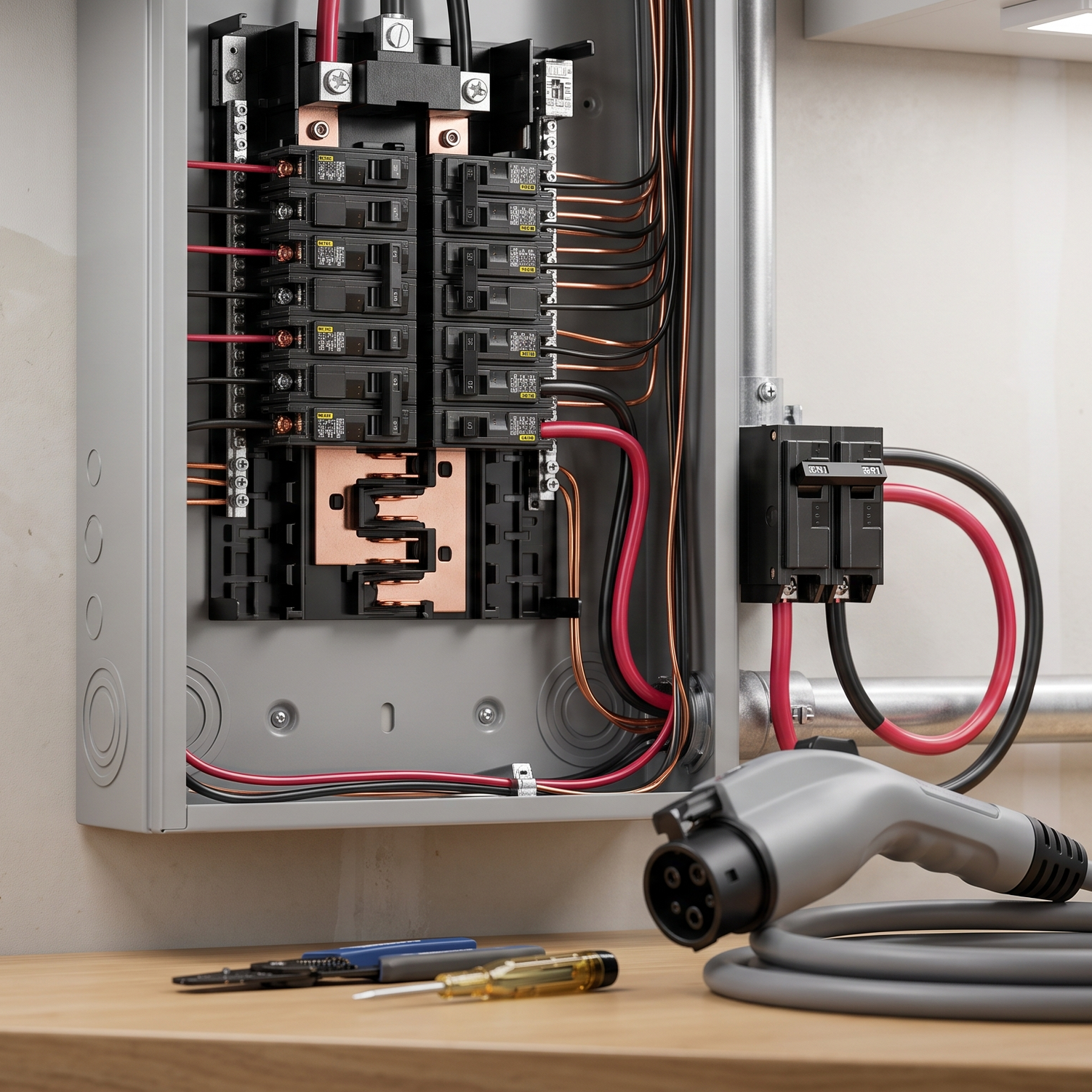
You bought the EV, the charger's in the box, and now you're wondering whether plugging in is as simple as it sounds or whether it means electrical work first. It's the right question to ask, because a home EV charger isn't a small load — it's one of the greater demands you can add to a house. Whether your panel can handle it comes down to capacity and space, and the honest answer is that it varies from home to home.
Why an EV Charger Is a Big Ask
A Level 2 home charger — the fast kind most owners want — typically runs on a dedicated 240-volt circuit drawing somewhere around 40 to 60 amps. That's comparable to adding a major appliance like an electric range or a hot tub to your electrical system, all at once, and often running for hours. So the question isn't whether your panel can technically connect a charger; it's whether your panel has the headroom to supply that much additional power on top of everything else your home already runs, safely and within its rated capacity.
That's why "do I need an upgrade?" doesn't have a one-size answer. It depends entirely on what your panel is rated for and how much of that rating is already spoken for.
The Two Things That Decide It
Total Capacity
Every panel has a maximum rating — commonly 100 amps in older homes or 200 amps in newer ones. Your existing loads (HVAC, appliances, lighting, everything) already use part of that. Adding a 40-to-60-amp charger requires that the panel have enough unused capacity to cover it without exceeding its safe limit. A 200-amp panel serving a modest load usually has room; a 100-amp panel already running central air and electric appliances often doesn't.
Available Circuit Space
Separately, the charger needs a physical open slot (a double-pole breaker space) in the panel to land its circuit. A panel can sometimes be at capacity for breaker spaces even if it has electrical headroom, or vice versa. Both the capacity and the physical space must be in place for a simple charger installation.
| Your situation | Upgrade likely needed? |
|---|---|
| Modern 200-amp panel, light existing load, open slots | Often no — charger can be added |
| 200-amp panel but heavily loaded or full of breakers | Maybe — depends on the load calculation |
| Older 100-amp panel with typical modern loads | Often yes — capacity is tight |
| 60-amp panel or older fuse box | Almost always yes — upgrade first |
| Outdated or recalled panel brand | Yes — upgrade for safety and capacity |
How an Electrician Figures It Out
The proper way to determine this is with a load calculation — an electrician adds up your home's existing electrical demand and compares it against your panel's rated capacity to see how much room is left, then checks whether a charger's circuit fits within it. They'll also look at whether there's an open breaker slot and whether the panel and service wiring are in good condition. This calculation is what turns "I think it'll be fine" into a real answer, and it's why a professional assessment is the right first step before buying into an install.
If the panel has room, adding the charger is a relatively contained job. If it doesn't, a panel upgrade — often to 200 amps — provides both the capacity and the slots, and it has the added benefit of future-proofing the home for other modern loads. Growing EV adoption is one of the most common reasons homeowners upgrade panels today.
TIP: Before you buy a specific charger, have an electrician assess your panel. The charger's amperage and your panel's spare capacity together determine what's possible, and knowing your situation first can influence which charger makes sense — sometimes a slightly lower-amperage charger fits an existing panel that a larger one wouldn't.